
Tihar Jail Recognises UpskillNexus on Independence Day for Contribution Towards Inmate Welfare, Reformation and Rehabilitation
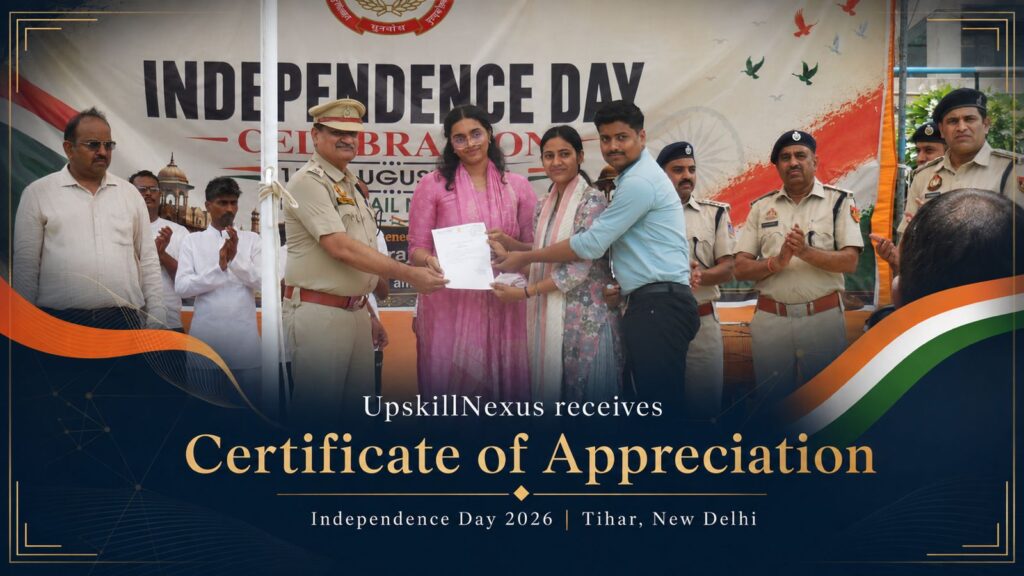
New Delhi | 15 August 2026: On the occasion of India’s 80th Independence Day, UpskillNexus was invited to participate in the Independence Day celebrations at Central Jail No. 8/9, Tihar, New Delhi, where our organisation received a Certificate of Appreciation from the Prison Administration in recognition of its contribution towards the welfare, reformation and rehabilitation of inmates. The certificate was presented by Dheeraj Mathur, Superintendent of Prison, Central Jail No. 8/9, Tihar, and formally acknowledges the contribution and dedicated efforts of UpskillNexus towards bringing positive change in the lives of inmates. For UpskillNexus, being recognised in the presence of the prison administration on Independence Day made the occasion particularly meaningful. It was not simply an acknowledgement of our efforts. It represented the larger role that education, awareness and skills can play in creating capability and positive change across different sections of society. A Meaningful Independence Day Recognition Independence Day is a reminder of the responsibilities that come with freedom — and of the work required to build a stronger, more capable and more inclusive India. For UpskillNexus, receiving this recognition at Tihar Jail on 15 August added a different dimension to that idea. The Certificate of Appreciation specifically recognises UpskillNexus’s contribution towards the welfare, reformation and rehabilitation of inmates, while placing on record the Prison Administration’s appreciation and gratitude for the organisation’s efforts. The recognition follows UpskillNexus’s engagement with Tihar Jail, including an Artificial Intelligence and Cybersecurity Awareness Session conducted for officials and staff of Central Jail No. 8/9. Approximately 40–50 participants took part in the awareness session, which focused on emerging technology, cybersecurity, digital safety and responsible use of Artificial Intelligence. The earlier engagement was designed around a simple objective: making complex and rapidly changing technology more understandable, practical and relevant to the people using it. A National Conversation Around Skills and Technology The timing of the recognition also coincided with a significant national conversation around skills and technology. In his Independence Day address from the Red Fort on 15 August 2026, Prime Minister Narendra Modi announced a target to provide Artificial Intelligence skilling to 1 crore young Indians over the next year. The announcement placed AI capability and future-ready skills prominently within India’s broader development agenda. The significance of this goes beyond Artificial Intelligence alone. India’s technological transformation is creating a growing need for people who can understand, use and adapt to new technologies. Artificial Intelligence, cybersecurity, automation and digital systems are increasingly becoming part of education, employment, governance and everyday life. The national focus on AI skilling reflects an increasingly important reality: capability-building is becoming a critical part of India’s next phase of growth. At UpskillNexus, this is closely aligned with why we exist. We believe that skills are not simply tools for getting a job. They can help individuals become more capable, confident and adaptable in a rapidly changing world. And that principle applies far beyond the conventional classroom. From Cybersecurity Awareness to Institutional Engagement The recognition from Tihar follows an earlier AI and Cybersecurity Awareness Session conducted by UpskillNexus for officials and staff at Central Jail No. 8/9. The session brought together approximately 40–50 participants and covered practical aspects of technology and cybersecurity, including: Artificial Intelligence and its real-world applications Emerging cybersecurity threats Phishing and social engineering Password security and multi-factor authentication Digital privacy and data protection Safe internet browsing Digital forensics Cybercrime awareness Responsible use of Artificial Intelligence Practical digital safety practices The session focused on real-world examples rather than technical terminology alone. Participants explored how cybercriminals exploit human behaviour, how AI is changing the threat landscape and how simple security practices can reduce digital risks. The engagement reinforced an important point: cybersecurity awareness is not merely the responsibility of IT professionals but also an institutional responsibility. Our earlier article on the engagement covers the session and its key takeaways in greater detail. Read: UpskillNexus Conducts AI & Cyber Security Awareness Session for Tihar Jail Officials Why Cybersecurity Awareness Matters Across Institutions As institutions become increasingly dependent on digital systems, cybersecurity awareness has become an important part of organisational resilience. Government institutions, businesses, educational organisations and public institutions increasingly rely on digital communication, connected devices, databases and online services. This creates new opportunities, but it also creates new risks. Phishing attacks, social engineering, identity theft, ransomware, malicious links and AI-enabled scams are becoming increasingly sophisticated. At the same time, Artificial Intelligence is making it possible to automate and personalise many forms of digital fraud. This makes AI and cybersecurity training increasingly relevant across sectors. For organisations, cybersecurity moves beyond a technical function. It also depends on the awareness and behaviour of the people who interact with digital systems every day. That is why cybersecurity awareness programmes can play an important role in building a stronger digital culture. At UpskillNexus, our approach to cybersecurity training has always been centred around practical learning — helping participants understand not only what a cyber threat is, but also how it can affect their everyday digital behaviour. Skills, Education and the Larger Idea of Rehabilitation The Certificate of Appreciation is particularly significant. The Prison Administration recognised UpskillNexus for its contribution towards the welfare, reformation and rehabilitation of inmates. Rehabilitation is a complex process. It involves much more than any single intervention, training programme or awareness session. However, education and skill development can form an important part of that larger ecosystem. Skills alone cannot define rehabilitation. But the ability to learn, develop capabilities and engage with a changing world can be an important part of preparing individuals for reintegration into society. This is why the recognition from Tihar matters to us. It acknowledges that our contribution, even through a focused institutional engagement, can form part of a much larger effort towards welfare, reformation and rehabilitation. Taking Skill Development Beyond the Conventional Classroom Skill development is often discussed in the context of colleges, universities, corporate workplaces and training centres. But the need for relevant knowledge does not stop at the boundaries of a classroom. Students need digital skills. Professionals need
UpskillNexus Becomes AI CERTs® Authorized Training Partner | AI Training in Delhi
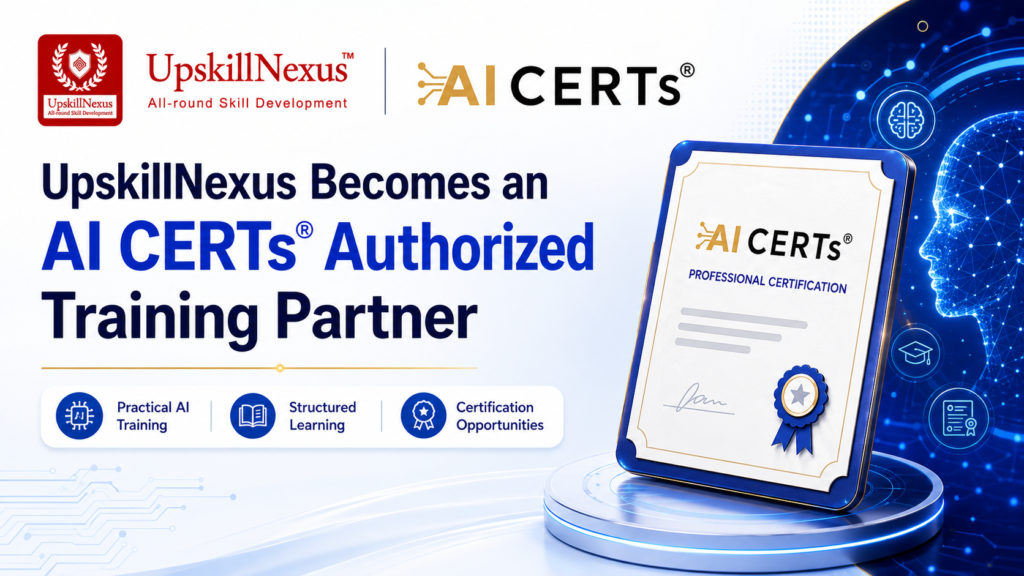
UpskillNexus is now an Authorized Training Partner of AI CERTs, expanding our focus on practical AI training, structured learning and AI certification opportunities for students and professionals in Delhi. Artificial intelligence is changing how businesses operate, professionals work and students prepare for future careers. From digital marketing and automation to business operations and technology, AI is becoming part of everyday professional workflows. At UpskillNexus, we believe learning AI should go beyond theory. Learners should understand the technology, explore practical applications, and develop skills they can use in real-world situations. Our new partnership with AI CERTs is an important step in that direction. Quick Answer: What Does the AI CERTs Partnership Mean? UpskillNexus is now an Authorized Training Partner of AI CERTs, expanding our AI learning and certification ecosystem for students and professionals. Through this partnership, learners can access role-based, vendor-neutral AI certification opportunities alongside practical AI learning options. AI CERTs offers certification programs designed around different professional roles and applications, with self-paced and instructor-led learning formats and online proctored certification examinations. For UpskillNexus learners, the partnership brings together: Practical AI Learning + Structured Training + Certification Opportunities What Does Our Partnership Mean for UpskillNexus Learners? AI is no longer limited to software developers or technology specialists. Digital marketers use AI for research, content workflows and automation. Business professionals use AI to improve productivity and processes. Entrepreneurs are exploring AI for business applications. Technology professionals are developing more specialized AI capabilities. This means AI skills are becoming relevant across different professional backgrounds. Through our partnership with AI CERTs, UpskillNexus is expanding its AI learning ecosystem with structured certification opportunities that can complement practical training. Our approach is simple: Understand → Apply → Demonstrate Understand: Build a strong foundation in AI concepts and applications. Apply: Explore how AI can be used in practical professional situations. Demonstrate: Use structured assessments and certification opportunities to validate your learning. The goal is to develop useful AI knowledge and understand how to apply it. What is AI CERTs? AI CERTs is an AI certification provider offering role-based and vendor-neutral certification programs designed around different professional and business applications of artificial intelligence. Its certification ecosystem includes different AI learning pathways and supports self-paced as well as instructor-led formats. AI CERTs also provides online proctored certification examinations as part of its certification programs. The role-based approach allows AI learning to extend beyond traditional technical roles into areas such as business, marketing, education, leadership, development and other professional applications. For learners, this can make it easier to identify an AI learning pathway that aligns with their existing skills and career objectives. Benefits of AI Certification Through AI CERTs A structured certification pathway can complement practical AI training in several ways. 1. Role-Based Learning Learners can explore AI certification pathways connected to specific professional roles and applications. 2. Flexible Learning Options AI CERTs supports self-paced and instructor-led learning formats, making it possible for learners to choose a format that fits their schedule. 3. Structured Assessment Certification programs include online proctored examinations, providing a structured assessment of the learner’s knowledge. 4. Structured Learning Resources AI CERTs provides learning resources designed to support the certification journey, including courseware and other learning materials. 5. Complementary Certification Certification can complement practical learning by giving learners an additional way to demonstrate knowledge gained through a structured learning pathway. Important: A certification should complement practical skills, not replace them. At UpskillNexus, we believe both are valuable parts of a strong learning journey. Practical AI Training at UpskillNexus UpskillNexus is a technology-focused training organization in Rajouri Garden, Delhi, providing practical learning opportunities for students, working professionals, freelancers and aspiring technology professionals. Our broader training ecosystem includes: Artificial Intelligence AI Automation Digital Marketing Cybersecurity Ethical Hacking Our focus is on helping learners understand concepts and connect them with practical applications. For someone looking for AI training in Delhi, the objective should not simply be to complete a course. The more important question is: Can you understand what you learned and apply it to a real situation? That’s the approach we encourage at UpskillNexus. AI Courses for Students and Working Professionals AI is becoming relevant to people from many different backgrounds. You don’t necessarily need to be a programmer to begin developing AI skills. Students Students can start building AI knowledge alongside their academic education and gain exposure to technologies that are becoming increasingly relevant across industries. Working Professionals Professionals can add AI capabilities to their existing expertise instead of completely changing their career path. Digital Marketing Professionals AI can support research, content workflows, analytics, automation and productivity. Digital marketers can explore how AI fits into modern marketing processes. Business Owners Business owners can explore AI for productivity, research, customer communication and workflow automation. Technology Professionals Technology professionals can explore more specialized AI learning pathways and certification opportunities. This makes AI education increasingly relevant to a much broader audience than traditional technology learners. Self-Paced AI Courses for Flexible Learning Not everyone can attend a fixed classroom schedule. Students have college commitments. Working professionals have jobs. Freelancers and business owners often have changing schedules. That’s where self-paced AI courses can provide additional flexibility. Learners can study according to their availability while following a structured learning path. AI CERTs also supports self-paced and instructor-led learning formats within its certification ecosystem. At UpskillNexus, learners can explore self-paced courses designed for people who prefer flexible learning. [Explore UpskillNexus Self-Paced Courses →] AI Training in Rajouri Garden, Delhi If you’re searching for AI training in Rajouri Garden or AI training in Delhi, UpskillNexus provides online and offline learning options from its training center in Rajouri Garden, West Delhi, near Rajouri Garden Metro Station. Our location provides an offline learning option for students and professionals in West Delhi, while online learning allows learners from other locations to participate as well. The right AI course ultimately depends on your current skills, professional background and learning objectives. Why Choose UpskillNexus for AI Learning? At UpskillNexus, our focus is on practical, career-oriented technology education. We want learners to understand
Why Learn Digital Marketing in 2026?

Why learn digital marketing in 2026? “Is it too late to learn digital marketing?” is one of the most common doubts we hear — usually from someone who’s watched the field for a few years and assumes the window has closed. It hasn’t. What’s changed in 2026 isn’t that the opportunity shrank — it’s that the entry point shifted, and understanding how it shifted is exactly why this is a good year to start, not a late one. The field didn’t mature — the toolset did Every year someone says digital marketing is “saturated.” What’s actually happened is that the basic, easily-automated tasks — writing a first-draft caption, pulling a routine report, testing ad variations — are increasingly handled by AI. That’s not bad news for a beginner starting now; it’s an advantage. You’re not learning a decade of legacy, manual workflows just to unlearn them. You’re learning the field as it actually works today, with AI as a default tool rather than a bolt-on skill you pick up later.Marketers who started 5–10 years ago are having to retrain around AI. Marketers starting in 2026 learn it as the baseline from day one. That’s a genuine head start, not a disadvantage. Hiring has shifted from pedigree to proof Traditional marketing roles historically gated on a business degree or an MBA. Digital marketing never fully did — and in 2026, that gap has widened further. Employers increasingly hire based on a demonstrable portfolio: a campaign you ran, a page you optimised and ranked, an ad account you managed, results you can show in a screenshot.This matters most if you don’t have a “traditional” background. Career switchers, non-commerce graduates, and people without a marketing degree aren’t at the disadvantage they’d face in most other white-collar fields — as long as they can build and show real work. There are simply more channels than there used to be A decade ago, “digital marketing” mostly meant search and a bit of social. In 2026, the channel list has multiplied — short-form video, AI-driven ad platforms, marketing automation, conversational commerce, influencer partnerships, retail media. More channels means more specialisation opportunities, and more roles for people who can operate even one or two of them well. Breadth was once the safe bet; today, depth in a specific channel (say, performance marketing on Meta, or technical SEO) is often the faster route to being genuinely hired for, not just trained in. The cost of starting is lower than almost any other skilled career path You don’t need expensive equipment, a licence, or years of unpaid apprenticeship to begin practising digital marketing. A laptop, a small ad budget, and a willingness to run real (even small) campaigns is enough to start building a portfolio — something few other in-demand career paths can say. Compare that to the capital or years required to break into most other specialised fields, and the barrier to entry looks unusually low for the earning potential on the other side. Waiting doesn’t reduce the learning curve — it just delays it The most common reason people delay is a version of “I’ll start once things settle “down”—once AI tools mature, once the platforms stop changing so fast. They won’t. Constant platform change isn’t a temporary phase digital marketing is passing through; it’s a permanent feature of the field, the same way it’s a permanent feature of software engineering or any other technology-driven career. The skill that actually matters isn’t “knowing today’s tools perfectly”it’s building the habit of adapting quickly. That habit is best built by starting now, not by waiting for a stable moment that never arrives. What “learning digital marketing” should actually mean in 2026 To be genuinely job-ready, not just certificate-ready, a 2026-relevant path should cover: – Core channels — SEO, Google Ads/SEM, and organic + paid social, not just one in isolation.- Analytics fluency — GA4 and Google Tag Manager specifically, since these are the current industry standard.- AI tools as a working habit—prompt engineering and AI-assisted content and campaign workflows, not as an afterthought module.- A real portfolio — live projects, not just recorded lecture completion. If you’re evaluating specific institutes against this bar, our companion post — [how to choose the best digital marketing institute in Delhi]— walks through exactly what to check before enrolling anywhere. The honest bottom line 2026 isn’t a uniquely perfect year to learn digital marketing — no single year ever is. But the specific claim that “it’s too late” doesn’t hold up: the entry barrier is still low, AI is a genuine multiplier for beginners who learn it as a default rather than an add-on, and hiring continues to reward demonstrable skill over pedigree. The people who’ll struggle aren’t the ones starting now — they’re the ones who keep waiting for a moment of stability that isn’t coming. Frequently asked questions 1. Is it too late to start a career in digital marketing in 2026?No. The field rewards demonstrable skill and portfolio work over years of tenure or a specific degree, so a 2026 start is not meaningfully “behind” — you’re learning current tools and AI workflows as the default, not retrofitting them onto older habits.2. Will AI make digital marketing skills obsolete?AI is automating routine, repetitive tasks (first-draft copy, basic reporting) but expanding the overall need for people who can set strategy, judge output quality and manage campaigns end-to-end. Learning digital marketing with AI as a built-in tool, rather than fearing it, is itself the advantage of starting now.3. Do I need a marketing degree to learn digital marketing in 2026?No. Hiring in this field is largely skills-first—a strong portfolio of real campaigns, rankings or managed ad accounts typically matters more to employers than formal marketing credentials.4. How long does it realistically take to become job-ready in digital marketing?This varies by course structure and your own consistency, but a well-built, hands-on program with live projects (rather than lecture-only content) is the biggest factor in getting job-ready within a reasonable timeframe. Ask any course
Online vs Offline Digital Marketing Course: Which Is Better?

Online vs offline digital marketing course: which is better? There’s no universally “better” format — there’s only the format that fits how *you* actually work and learn. This post breaks down the real trade-offs across cost, discipline, networking and hands-on practice, so you can pick based on your own habits rather than whichever option a salesperson pushes harder. The honest starting point: format doesn’t decide the outcome, effort does Before comparing, one caveat that applies regardless of what you choose: neither format compensates for a course with weak curriculum, no live projects, or no real placement support. A great offline course beats a mediocre online one, and a great online course beats a mediocre offline one. Pick the *institute* first using a proper checklist (see our [guide to choosing a digital marketing institute in Delhi] )— then decide the format. With that said, here’s how the two genuinely differ. Cost and commute Offline courses carry an implicit cost beyond the fee: daily commute time and transport expense. If you’re based near the institute — say, within reach of Rajouri Garden Metro — this cost is small. If you’re commuting from across NCR, it adds up in both time and money, and commute fatigue is a real reason people drop off mid-course. Online commute entirely, which is often the deciding factor for working professionals fitting classes around a job, or students juggling college alongside the course. Discipline and accountability This is where people are least honest with themselves. Offline classes build in structure — you’re physically present, in a room, on a schedule you can’t quietly skip. For learners who know they need external accountability to stay consistent, this matters more than any other factor on this list. Online demands more self-discipline. Live, instructor-led online batches (not pre-recorded videos) narrow this gap significantly, since you still have fixed class times and a visible instructor but you can still mute your camera and drift. Be honest about whether you’re someone who finishes what they start without someone watching. Networking and peer learning Offline classrooms create incidental networking — the person next to you might become a referral source, a collaborator, or just someone to compare notes with during a tough module. For freelancers and career switchers particularly, this informal network can matter as much as the curriculum. Online networking is possible but has to be more deliberate — through group projects, community channels or instructor-facilitated introductions. It rarely happens by accident the way it does in a physical room. Hands-on practice and tool access This is less about format and more about how the institute runs its labs — but the pattern generally holds: Offline sessions typically make it easier for instructors to walk over and troubleshoot your screen directly, which speeds up debugging when a campaign setup or a tool isn’t working as expected. Online, live instructor-led sessions with screen-sharing largely close this gap, especially for digital marketing (unlike, say, hardware-based training) since almost everything — Google Ads, GA4, SEO tools, AI tools — is cloud-based and equally accessible either way. Doubt-clearing speed Offline: doubts get cleared in real time, in the room, often before you’ve even finished asking the question. Online: live sessions still allow real-time doubt-clearing via chat or voice — the difference is smaller than most people assume, as long as the batch is genuinely live and not a recorded-video format with delayed forum replies. Flexibility Offline is fixed — you show up when the batch runs, full stop. Online batches are typically more flexible on rescheduling a missed class or catching a recording of a live session you couldn’t attend live. For people with unpredictable schedules — freelancers with client deadlines, professionals with variable shift timings — this flexibility can be the deciding factor. Quick comparison Factor Offline Online (Live, Instructor-Led) Commute Cost Time and travel expenses required No commute cost Built-in Accountability Strong classroom discipline and attendance Moderate; requires self-discipline Networking Opportunities Natural face-to-face interactions Possible, but requires proactive participation Hands-on Tool Access Excellent practical lab experience Excellent via cloud-based tools and screen sharing Doubt Clearing Immediate, in-person support Fast, provided classes are genuinely live Schedule Flexibility Fixed class timings Greater flexibility; easier to catch up if you miss a class Who should choose which – Choose offline if: you’re within a reasonable commute, you know you need external structure to stay consistent, and in-person networking matters to your goals (e.g. you want an internship referral pipeline). – Choose online if: you’re a working professional or student with a tight or unpredictable schedule, you’re outside comfortable commuting distance, or you’re already disciplined enough to treat a live online class with the same seriousness as an in-person one. – Consider a hybrid option if it’s available — some institutes let you mix classroom sessions with live-online catch-ups, giving you the accountability of offline with the flexibility of online when life gets in the way. The trap to avoid: choosing based on price alone A cheaper “online-only” course is not automatically the better financial choice if you’re the kind of learner who needs a room and a deadline to actually finish. Unfinished courses are the most expensive kind — you’ve paid the fee and gained nothing. Choose the format you’ll actually complete, not the one that looks cheapest on paper. Frequently asked questions 1. Is an online digital marketing course as effective as an offline one? Yes — provided it’s live and instructor-led, not pre-recorded videos. Since almost all digital marketing tools (Google Ads, GA4, SEO platforms, AI tools) are cloud-based, hands-on practice quality is comparable across both formats. The main differences are accountability structure and networking, not learning quality. 2. Which is cheaper — online or offline digital marketing courses? Course fees themselves are often similar for the same curriculum; the real cost difference is commute time and transport for offline students. Factor in your actual commute cost before comparing on fee alone. 3. Can I switch between online and offline batches mid-course? This depends entirely on the institute — ask specifically before enrolling if you
How to choose the best digital marketing institute in Delhi
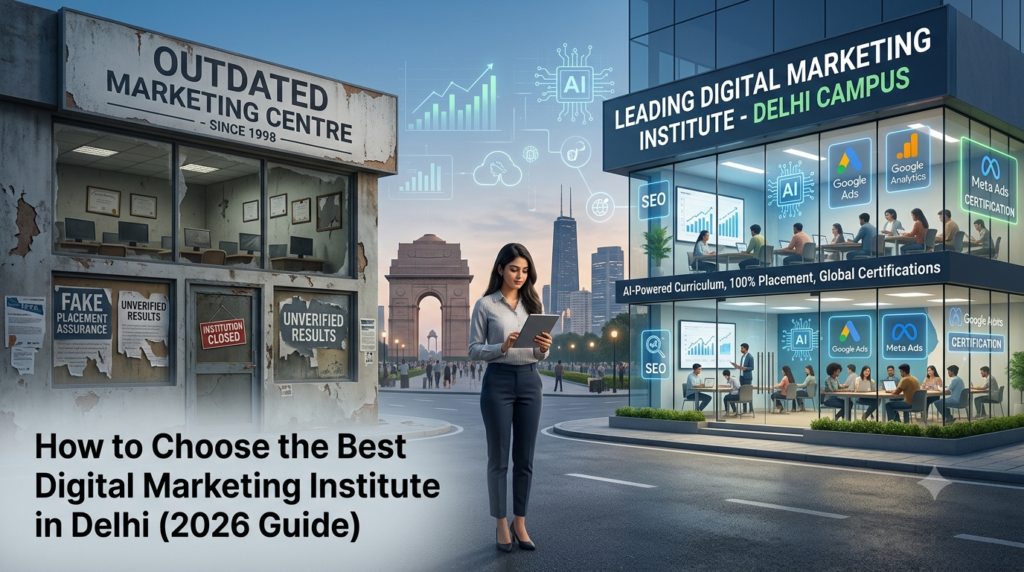
Delhi has no shortage of institutes promising to make you job-ready in 3 months. Some are excellent. Many are a slide deck, a WhatsApp group, and a placement cell that stops replying after you’ve paid. The problem isn’t finding an institute — it’s telling the two apart before you’ve spent the money.This is a practical checklist, not a sales pitch. Use it to evaluate any institute you’re considering, including ours. Start with the curriculum, not the brochure Brochures are marketing. What matters is the actual module breakdown — ask for it before you enrol, not after.A genuinely modern digital marketing curriculum in 2026 should cover, at minimum:– Search marketing — SEO (on-page, technical, local) and SEM/Google Ads, not just one or the other.- Social media — organic strategy *and* paid campaigns (Meta Ads, not just “posting content”).- Performance marketing & CRO — landing pages, funnels, conversion rate optimisation.- Analytics — GA4 and Google Tag Manager specifically; older institutes still teaching Universal Analytics are behind.- AI in marketing — prompt engineering and AI tools for content, research and automation. If a course doesn’t mention AI at all in 2026, that’s a red flag on its own.- E-commerce or affiliate marketing, if you’re interested in that track.Ask: how many modules, how many hours of live (not recorded) instruction, and what’s the practical-to-theory ratio? An 80/20 practical-to-theory split is a reasonable industry benchmark — anything mostly lecture-based will leave you with knowledge but no portfolio. Check what tools you’ll actually get hands-on with A good institute teaches on real, current tools — not just talks about them. At minimum, look for hands-on time with:– SEO/analytics tools — Google Search Console, Google Analytics, Semrush or Moz, Google Keyword Planner.- Ad platforms — Google Ads (with its transparency center), Meta Business Suite.- Content & design— Canva, Grammarly, a website builder like WordPress or Elementor.- AI tools — ChatGPT, Claude, Gemini and at least one AI content/creative tool.- Reporting — Google Looker Studio or an equivalent dashboarding tool.If an institute can’t name specific tools you’ll work in — only “we cover Google Ads and SEO” — push for specifics before you pay. Ask about certifications — but verify what’s actually included Institutes advertise certifications heavily, and it’s easy to conflate “we prepare you for X certification” with “X certification is included in the fee.” They’re not the same thing.Ask directly:1. Which certifications are included in the course fee, and which are optional, at extra cost?2. Are they platform certifications (Google, Meta, HubSpot) or only the institute’s own certificate?3. Is there a genuine assessment—practical and theoretical — or is the certificate given on attendance alone?A program with a real, dual (practical + theoretical) assessment and a mix of institute + platform certifications is a stronger signal than one offering a single “master certificate” with no breakdown. Placement support: ask how, not just if Almost every institute claims “placement assistance.” Almost none define what that means. Before you enrol, ask specifically:- Does support include interview preparation, resume building and LinkedIn optimisation — or just a WhatsApp group of job postings?- Is there an internship built into the program, or is placement help only after the course ends? Is placement “guaranteed,” or is it phrased as assistance “as per company policy”? Be sceptical of any institute promising guaranteed placement — hiring ultimately depends on your performance in interviews and the hiring company’s decision, and no institute controls that outcome. A credible institute will phrase this honestly rather than promise a job. Location and format — be realistic about your own habits Delhi NCR has real commute costs (time, money, energy) that affect whether you’ll actually finish the course. Before choosing:– If you’re picking an offline/classroom program, check the actual commute from your home or office — not just “it’s in Delhi.” An institute in Rajouri Garden convenient for West Delhi (Tilak Nagar, Janakpuri, Subhash Nagar, Tagore Garden) may be a poor fit if you’re based in Noida or Gurugram, and vice versa.- If online works better for your schedule, confirm the online batches are live and instructor-led, not just pre-recorded videos with no interaction.- Ask about batch size. Smaller batches generally mean more mentor time per student — worth asking directly what the typical batch size is. Fees: what to ask (and what to ignore) Most reputable institutes don’t publish fees openly on their website, since pricing often depends on the specific track, batch and any ongoing offers — that’s normal, not a red flag by itself. What is worth asking directly:– What’s included in the base fee — is there anything charged separately later (certifications, resources, retake fees)?- Are there need-based scholarships or EMI options, and what’s the actual process to apply?- Can you get the fee structure in writing before you commit, rather than relying on a verbal quote?Ignore high-pressure “offer ends today” tactics. A genuine institute will let you take a free demo class and think it over. Red flags that should make you walk away – Guaranteed placement or a specific guaranteed salary. No legitimate institute can guarantee an employer’s hiring decision.- No live projects or portfolio component — a course that’s 100% theory won’t get you hired on its own.- Vague answers about faculty. Ask who’s actually teaching — working professionals in the field, or only full-time trainers with no current industry experience?- Pressure to enrol immediately without a demo class or a chance to review the curriculum.- No mention of AI tools anywhere in the curriculum, in a field that’s changed this much in the last two years. A quick checklist before you enrol anywhere Before signing up for any digital marketing institute in Delhi, you should be able to answer:– [ ] What’s the exact module count and live training hours?- [ ] Which specific tools will I get hands-on practice with?- [ ] Which certifications are included vs. optional/extra cost?- [ ] What does placement support actually include, and how is it phrased (assistance vs. guarantee)?- [ ] Is the
Is Digital Marketing a Good Career in India in 2026?
Is digital marketing a good career in India? yes — but not for the reasons most digital marketing is booming articles tell you. If you’ve landed here, you’ve probably already read a dozen pages promising six-figure salaries and “work from anywhere” freedom. You’re right to be sceptical. This is the honest version: what the digital marketing career scope in India actually looks like in 2026, what you’ll realistically earn, who’s hiring, and where the genuine risks are — including whether AI is about to make the whole field redundant. By the end you’ll be able to decide whether this is the right move for you, not for the influencer trying to sell you a ₹50,000 course. What is the current demand for digital marketing professionals in India? Demand is real, and it’s structural rather than hype. India’s digital advertising market is projected to nearly double to around US$22 billion by 2030, according to the [India Brand Equity Foundation (IBEF)](https://www.ibef.org/news/india-s-digital-advertising-market-is-projected-to-nearly-double-to-us-22-billion-by-2030). When ad budgets move online at that scale, someone has to plan, run and measure those campaigns — and that someone is a digital marketer. It’s already happening, not a future promise. Digital media now accounts for roughly 46% of India’s ₹1,00,000 crore (≈US$11.4 billion) advertising market, per [IBEF, citing Crisil](https://www.ibef.org/news/digital-media-claims-46-of-india-s-rs-1-00-000-crore-us-11-41-billion-advertising-market-crisil). Digital has overtaken print and is closing in on television. Every rupee that shifts from a newspaper ad to a Meta or Google campaign is demand for people who understand performance marketing, SEO, content and analytics. On the talent side, [LinkedIn’s Skills on the Rise 2026 for India](https://www.storyboard18.com/brand-makers/linkedins-skills-on-the-rise-2026-identifies-top-skill-stacks-reshaping-indias-workforce-90556.htm) lists digital and AI-driven marketing skills among the fastest-growing the platform tracks — a signal that employers are actively short of these skills, not flooded with them. That gap is exactly where digital marketing jobs in demand in India come from. The honest caveat: demand is strongest for people who can prove they can run a campaign, not for people who merely hold a certificate. More on that below. What salary can you expect: entry-level vs 3 years’ experience? Here’s the realistic picture of digital marketing salary in India in 2026, based on aggregated industry salary reports (verify current ranges before quoting these as fixed): – Entry-level (0–1 year): roughly ₹2.5–4.5 LPA (about ₹25,000–40,000/month). Notably, that’s already higher than many traditional fresher roles, which often start at ₹15,000–25,000/month. – Mid-level (3–5 years): typically ₹6–10 LPA, with metro roles in Delhi, Mumbai and Bangalore at the upper end. – Senior / managerial (5+ years): ₹12–20 LPA and above, with specialists in performance marketing and marketing analytics often beyond that. Two honest points. First, the jump from entry to mid-level is driven by demonstrable results — a candidate who can show “I scaled this account from ₹1L to ₹5L/month at a 4× ROAS” earns far more than one who can only list tools. Second, location and specialisation matter more than your degree: a skilled performance marketer in Rajouri Garden, Delhi can out-earn a generalist with a fancier CV elsewhere. Which industries hire the most digital marketers in Delhi NCR? Delhi NCR is one of India’s densest hiring markets for digital roles, and demand clusters in a few fast-growing verticals: – E-commerce & D2C brands — performance marketing and retention are core to their P&L, so they hire aggressively.– EdTech — heavy paid-acquisition and content engines; a large NCR employer base.– Healthcare & wellness — rapidly digitising patient acquisition.– IT / SaaS services — demand-generation, SEO and marketing automation roles.– Agencies — the fastest way for freshers to get *breadth* across many client accounts in a short time. For someone based in West Delhi, the practical advantage is access: agencies and brand offices across Rajouri Garden, Connaught Place and Gurugram are commutable, and local institutes with placement networks plug you straight into that pipeline. (If you’re weighing structured training, our [Digital Marketing course in Rajouri Garden](/digital-marketing-course-in-rajouri-garden) is built around exactly this NCR hiring market.) Is digital marketing better than a traditional marketing career? “Better” depends on what you want, but a few differences are objective: – Speed of entry. Traditional marketing roles often gate on an MBA. Digital marketing is skills-first—a strong portfolio can get you hired without one.– Measurability. Digital work is accountable to numbers (CTR, CAC, ROAS). That’s pressure, but it’s also how you prove value fast and get promoted.– Lower entry cost. You can learn and practice with a laptop and small ad budgets; you don’t need to wait for a big brand to “give you a brief.”– Optionality. The same skills work in a job, as a freelancer, or for your own venture. The trade-off: traditional brand-marketing roles can offer deeper strategic and creative scope early on, and some legacy industries still prefer the MBA route. Digital marketing rewards people who enjoy continuous learning — the platforms change every quarter. If that sounds exhausting rather than exciting, be honest with yourself now. What skills do you need to get a digital marketing job in India? This is where most aspirants go wrong — they collect certificates instead of building proof. Employers in 2026 hire for: 1. Performance marketing — Google Ads and Meta Ads, with real budget-handling experience.2. SEO & content — keyword research, on-page optimisation, and content that ranks.3. Analytics — GA4, Google Tag Manager, and the ability to read data and act on it.4. Marketing automation & email/CRM — basic funnels and lifecycle flows.5. AI fluency — using tools like ChatGPT and AI ad features to work faster (a multiplier, not a replacement — see the next section).6. A portfolio — live campaigns, a ranked blog, a managed social account, or a documented case study. This is the single biggest differentiator between candidates who get hired and those who don’t. A structured program helps here only if it’s hands-on. Our [Digital Marketing course](/courses/digital-marketing) is built around live projects and current tools so you graduate with a portfolio, not just a certificate. Is digital marketing a stable career, or will AI replace it? This is the real fear behind the
AI Job Crisis 2026: 973 Jobs Lost Daily: What You Must Do

In 2025, 246,000 tech jobs disappeared. In 2026, that’s going to be 973 cuts a day. The companies doing the cutting aren’t struggling; they’re reporting record revenues. 246K Laid off in 2025 973/day Job cuts in 2026 9× Rise in AI-cited cuts 340% Surge in AI job postings It’s already happening Every company below cited AI capability, not financial difficulty, as the reason. Sources: company press releases, SEC filings, layoffs. FYI. Company Context Jobs Cut Oracle 2026 · AI cloud infrastructure pivot 30,000 Amazon Jan 2026 · Flattening management layers 16,000 Microsoft 2025 · Two rounds — May + July 15,000 IBM 2025 · AI agents replaced HR & admin roles 8,000 Block Mar 2026 · “AI can do a wider range of tasks.” 4,000 Atlassian Mar 2026 · “AI changes skill mix needed.” 1,600 Nearly 246,000 tech workers were let go in 2025. 2026 is worse. The companies cutting aren’t in trouble — they’re running leaner teams and making more money. Amazon reported $716 billion in revenue and cut 16,000 corporate roles. Oracle became a top AI cloud platform and laid off 30,000. Microsoft poured billions into OpenAI and trimmed 15,000 jobs. IBM replaced HR departments with AI agents and cut 8,000 staff. Tech layoffs by year Numbers were verified across TrueUp, Crunchbase News, RationalFX, and TechCrunch. Different trackers report slightly different totals depending on methodology. Year Global Layoffs Per Day Primary Driver 2022 ~165,000 ~452 Post-COVID over-hiring correction 2023 ~262,735 ~720 — PEAK All Big Tech cut simultaneously; recession fears 2024 ~152,922 ~418 AI adoption quietly begins replacing roles 2025 ~245,953 ~674 AI explicitly cited as the primary cause 2026* 90,524+ 963 ↑ AI automation now #1 stated reason (Jan–Apr only) Who cut the most, and why Every company below cited AI capability, not financial difficulty, as the reason. Sources: company press releases, SEC filings, layoffs. FYI. Company Context Jobs Cut Oracle 2026 · AI cloud infrastructure pivot 30,000 Amazon Jan 2026 · Flattening management layers 16,000 Microsoft 2025 · Two rounds — May + July 15,000 IBM 2025 · AI agents replaced HR & admin roles 8,000 Block Mar 2026 · “AI can do a wider range of tasks.” 4,000 Atlassian Mar 2026 · “AI changes skill mix needed.” 1,600 “This decision is not driven by financial difficulty but by the growing capability of AI tools to perform a wider range of tasks.” – Jack Dorsey, CEO of Block, announcing 4,000 layoffs, March 2026 What most people miss IBM cut 8,000 administrative roles while simultaneously hiring more engineers. Amazon eliminated management layers and automated the workflows underneath. The jobs didn’t vanish — they shifted. Every role AI absorbed opened a gap for someone who could build or manage that AI. LinkedIn data from early 2026 shows AI-specific job postings up 340% since 2024. But only for people who can demonstrate hands-on skills. Not “I’ve used ChatGPT.” The ones who are doing fine While hundreds of thousands are being cut, a smaller group is getting promoted, landing clients, and charging more. The difference isn’t experience or credentials. It’s one thing: the ability to build real stuff with AI. They automate business workflows. They build knowledge retrieval systems over company documents. They deploy voice AI agents. They ship production-grade applications without traditional code. And they can show you on day one. Old roles vs. new roles When ATMs arrived, bank teller jobs shrank — but ATM maintenance, cybersecurity, digital banking, and app development exploded. Same pattern, faster. Shrinking Growing Manual data entry & processing AI workflow designer & automation builder Basic customer support (Tier 1) AI chatbot trainer, manager & QA Junior software tester (manual) Prompt engineer & testing automation lead Traditional HR screener AI-assisted talent strategy & people ops Copy-paste report writer RAG system builder Tier-1 IT helpdesk AI agent deployer & automation consultant Which roles are actually at risk Based on the 365 DataScience Layoffs Report and WEF Future of Jobs 2025: Risk Role Impact Why High HR & Talent Sourcing 27.8% AI screens 1,000 CVs in seconds, schedules interviews, sends offers automatically High Data Entry & Processing ~22% Fully repetitive — AI is faster, cheaper, 24/7, near-zero errors High Customer Support (Tier 1) ~15% AI chatbots resolve 80% of common queries with no human involved Medium Junior Software Engineers 22.1% Routine coding automated; senior and AI engineers still in high demand Medium Basic Marketing & Copywriting ~12% Template content automated; strategy and creative still require people Medium Financial Reporting ~10% Routine reconciliation automated; advisory and forecasting still safe Safe AI Engineers & Builders Hiring ↑ Fastest-growing category — companies are urgently hiring Safe AI Automation Consultants Hiring ↑ Freelancers building automations command premium rates The gap 2.4M Unfilled AI roles globally (WEF 2026) 340% Rise in AI job postings since 2024 30–60% Higher pay for AI-fluent roles That 2.4 million gap is real, measurable, and time-limited. In 18–24 months, as more people upskill, the market will tighten. The people gaining ground right now moved before they felt ready. How it unfolded Q1 2025 — Corporate AI adoption crosses 50% globally McKinsey found 52% of enterprises had deployed AI in at least two business functions, up from 20% in 2022. It moved from pilot project to core infrastructure in under three years. Mid 2025 — Knowledge workers see first significant displacement Contrary to popular belief, AI’s first major job impact wasn’t manufacturing. It hit copywriting, paralegal work, financial analysis, and customer support — roles that required four-year degrees and paid above median. Late 2025 — Companies hiring more people, but only in AI-adjacent roles IBM, Amazon, and Salesforce all announced layoffs and
India AI Impact Summit 2026: The Global AI Agenda

Have you ever wondered who gets to set the rules for the “intelligent machines” of the future? For many years, the world’s greatest questions about artificial intelligence were answered in Silicon Valley, London, or Brussels. But in February 2026, the spotlight shifts to New Delhi. For five days, from February 16 to 20, 2026, the historic Bharat Mandapam will serve as the global hub for AI governance, innovation, and impact at the India AI Impact Summit 2026. This is no ordinary tech conference with keynote speeches and corporate networking. This is where the future rules of AI are being written, not just for profit, but for people and the planet. If you are interested in how AI will impact your work, education, healthcare, agriculture, or even climate change, this summit is for you. Let’s get into the details. What Is the India AI Impact Summit 2026? The India AI Impact Summit 2026 is the first major global AI conference in the Global South with a new narrative: Not just AI safety.Not just AI innovation.But AI has an impact. 📍 When: February 16-20, 2026 📍 Where: Bharat Mandapam, New Delhi 📍 Core Theme: “Sarvajan Hitaya, Sarvajan Sukhaya”(Welfare for All, Happiness for All) Unlike previous global AI summits that were mainly about risk management and regulation, India’s AI summit asks a more pragmatic question: How can AI make a difference in people’s lives? From small farmers to entrepreneurs, from students to scientists, the focus is on inclusivity. The Master Framework: 3 Sutras and 7 Chakras The Indian government has structured the summit around notions that have been developed from their philosophical foundations, a combination of ancient knowledge and modern technology. The Three Sutras People AI must be people-centric, with respect to human dignity, culture, and ethics.This includes reducing bias, being transparent, and making AI systems accountable. Planet AI development must be planet-friendly.Since massive data centers are massive energy consumers globally, “Green AI” focuses on reducing carbon emissions and improving energy efficiency. Progress AI must trigger economic progress, but inclusive progress, not only for a few corporations or countries. These three tenets of AI development set the ethics of AI development. The Seven Chakras (Action Areas) These are the implementation areas where policies, partnerships, and commitments are discussed and decided. Human Capital Upskilling and reskilling the Indian workforce for AI-driven jobs on a massive scale. Inclusion for Social Empowerment Ensuring that women, rural communities, farmers, and persons with disabilities benefit from AI development. Safe & Trusted AI Developing mechanisms to reduce bias, enhance explainability, and improve transparency. Science Using AI to unlock scientific breakthroughs in climate science, drug discovery, genomics, and public health. Resilience, Innovation & Efficiency Developing energy-efficient computing infrastructure and AI ecosystems. Democratizing AI Resources Enabling startups and scientists, and not just tech companies, to access compute resources and data. AI for Economic Development & Social Good Applying AI in healthcare diagnosis, agriculture, education, and governance. This structure allows the discussion to move from theory to practice. Who’s Attending? This summit is attended by the world’s power centers. 🇮🇳 Government Leadership The Prime Minister of India, Narendra Modi, is launching the summit along with several heads of state. 🌍 Global Tech Leaders Sundar Pichai (CEO, Google) Sam Altman (CEO, OpenAI) Jensen Huang (CEO, NVIDIA) 🧠 AI Researchers Yoshua Bengio Yann LeCun This is a level of engagement that is more like an “AI Olympics.” Success Story Spotlight: AI by HER One of the most interesting projects under the aegis of this summit is AI by HER, which is a challenge that highlights women-led AI startups. The winning solution was based on satellite imagery and machine learning to predict water shortages weeks in advance. However, the most interesting part was not just the prediction. It was the ability to translate complex satellite imagery into simple voice messages in local languages that empowered rural women farmers to protect their crops. This is an important proof of something important: The impact of AI is not about complexity.It is about accessibility. The India AI Impact Expo The summit also has a massive expo with 300+ exhibitors. What to expect: AI that translates local dialects in real-time Diagnostic AI that helps doctors in rural areas Climate modeling tools Agricultural intelligence platforms This is where policy meets prototype. Innovation Challenges To encourage grassroots innovation, the summit has major competitions: AI for ALL AI by HER YUVAi (for youth aged 13-21) The prize pool can go up to ₹2.5 crores, encouraging students, startups, and researchers to develop scalable AI solutions. All winners will be recorded in an official AI Innovation Compendium. Why India Is Hosting This Now India is currently implementing the IndiaAI Mission, which has been supported by ₹10,370 crores of funding. With: One of the largest developer bases in the world A rapidly developing AI startup ecosystem An ever-expanding digital infrastructure India is now setting itself up as a leader in the development of responsible and inclusive AI, particularly for the Global South. Why This Summit Matters to You If you are: A student getting ready for an AI-enabled job market A startup founder working on AI solutions A policymaker thinking about regulation Or just a curious citizen The frameworks and commitments that will be formed here will have an impact on: AI governance frameworks Investment patterns Education policies Startup ecosystems Global collaboration frameworks This is not a local event.It is a global signal. Final Thoughts The India AI Impact Summit 2026 is a change in power and perspective. The AI dialogue is no longer limited to Western tech capitals.It is expanding to include diverse realities, new economies, and inclusive growth. Technology must not only be smart.It must be responsible.It should be sustainable.And most importantly, it should be for humanity. The decisions that will be made in New Delhi this week could shape the future of AI over the next decade. The real question now is: What problem would you like AI to solve for India? Let us know because
How to Register for the India AI Impact Summit 2026
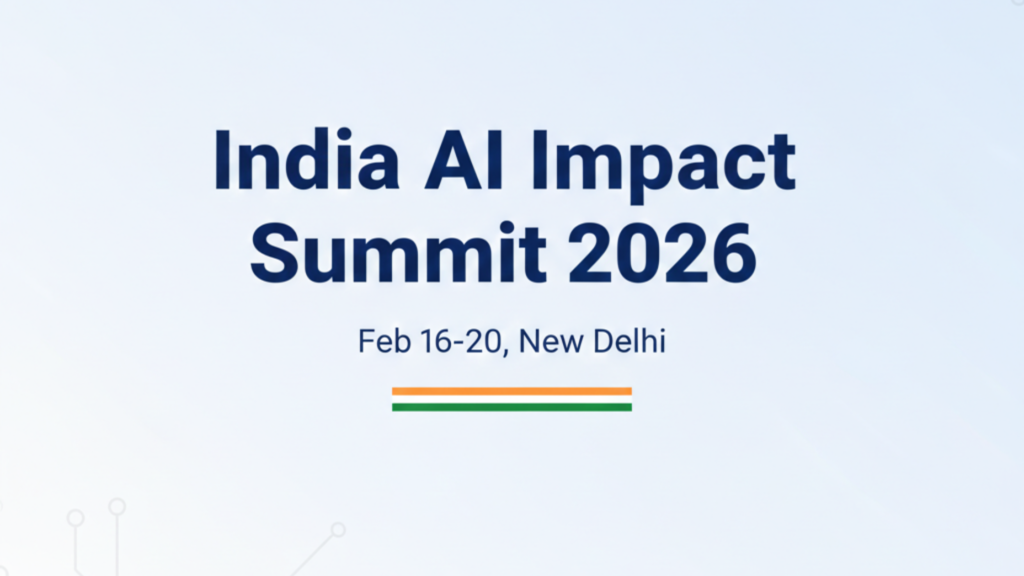
If you are interested in attending the India AI Impact Summit 2026, the registration process is designed to accommodate different categories of participants, from students to policymakers. Step 1: Visit the Official Summit Portal Go to the official India AI Impact Summit website under the IndiaAI Mission platform. Registration is handled digitally. Step 2: Choose Your Category You will be asked to register under one of the following categories: Student Startup Founder Industry Professional Researcher Government Representative Media Delegate Each category may have slightly different access privileges. Step 3: Select Access Type There are generally two participation tracks: 🔹 Expo & General Sessions Pass Open to registered visitors, including students and professionals. This pass allows access to: India AI Impact Expo Public keynote sessions Innovation showcases Networking areas 🔹 High-Level Roundtables & Closed-Door Sessions These are typically invitation-based and reserved for: Government officials Global AI leaders Policy experts Institutional representatives Step 4: Submit Required Details Applicants must provide: Basic personal information Organization or institutional affiliation Area of interest (AI governance, startups, research, etc.) Identification proof for security clearance Step 5: Confirmation & Entry Pass Once the application is reviewed: A confirmation email is sent A digital entry badge or QR-based pass is issued Participants must carry ID verification on-site at Bharat Mandapam Early registration is strongly recommended due to high international participation. Watch the Full Video Guide To better understand the registration process and key highlights of the summit, you can watch our detailed video explanation below: ▶️ YouTube: AI IMPACT SUMMIT DELHI📲 Instagram: AI Impact Summit 2026 The video covers the complete registration steps, participation categories, and important guidelines to help you apply smoothly.
The Rise of the Mineable Self as a Global Commodity
What if I told you that the most valuable resource in today’s digital economy isn’t oil, data centers, artificial intelligence, or rare earth minerals? It’s you. Not your job title. Not your degree. Not even your skills alone. Your identity, your story, your opinions, your emotions, your lifestyle, and your experiences have quietly become powerful economic assets. Welcome to the age of the “mineable self.” What Is the Mineable Self? Historically, mining referred to the extraction of oil, gold or minerals from the earth. Today, digital platforms are extracting something new: Personal stories Attention Data Emotions Online behavior This commodity is infinitely renewable. As long as humans exist, stories will exist. And in the digital economy, stories will have value. In this new market, everyone has a story, and every story can be mined. How Technology Made Humans into Commodities The technology platforms of Instagram, YouTube, Netflix and LinkedIn have completely changed the way value is created in the digital economy. In the past, production and visibility were in the hands of powerful gatekeepers. Large corporations dominated content creation, film studios dictated storytelling, and media conglomerates decided who got public attention. Access to audiences was limited and power rested in the hands of a few gatekeepers. Today, this has completely changed. Now, anyone with a smartphone and internet access can create content, build a personal brand and reach a global audience. This has given people unprecedented freedom and opportunities. People are no longer just consumers of content; they are producers, influencers and entrepreneurs in their own right. But this has also brought about a new reality. As technology platforms monetize engagement and attention, human identity itself becomes a commodity in the marketplace. Personal experiences become shareable stories, opinions drive engagement and even struggles get views and clicks. In this reality, life becomes content, identity becomes a brand, and human beings become marketable commodities in the attention economy of the digital world. The Attention Economy In the current digital age, attention equals money. Today, websites do not only compete for your purchasing power but also for your time. The more time you spend on a website, the more data you produce, and the more valuable you become to the system. The attention economy values engagement more than money. You are the one who creates your identity, and your identity is what drives the algorithms, and the algorithms drive the digital markets, and these digital markets drive profits. In the attention economy, you are both the consumer and the product. The Impact of AI Artificial intelligence has greatly fueled the process of converting human identity into a quantifiable economic value. AI algorithms are constantly analyzing what you are interested in, what you watch, what you buy, and how you interact with the internet. Every click, search, scroll, and pause is data that is fed into these algorithms. These algorithms use predictive analytics to analyze your interests, forecast your behavior, and tailor the content you see. In this manner, AI systems enhance the mechanisms of the attention economy by converting human behavior into valuable insights. However, AI also has a profound impact on content creation. Generative AI applications assist individuals in writing posts, editing videos, creating visuals, and automating communication. Storytelling has become quicker, more efficient, and more optimized for engagement. This has made it easier for people to create content while also making it more competitive. In this manner, we are now living in a digital world where identity is constantly being measured, optimized, and refined for performance. Human expression is no longer personal but data-driven. In the world of AI, identity is not only defined by who we are but also by how algorithms interpret and monetize our behavior. Is This Empowering or Exploitative? There are definite advantages: Democratization of media New job opportunities Rise of creators and influencers Personal branding as economic power However, there are also potential downsides: Loss of privacy Need to perform constantly Emotional exhaustion Use of personal life as a public product The distinction between living and branding is becoming increasingly blurred every day. The Big Question If the self has become the newest global commodity, more renewable than oil and more scalable than gold, then the big question is not whether this trend will continue. It will. The digital economy is already organized around identity, attention, and data as its new drivers. The big question is whether we will control our digital selves or whether our digital selves will be controlled by algorithms and markets. In a world of streaming media, social media, and artificial intelligence, the most valuable resource may not be technology but the human story that drives it. Conclusion We are on the threshold of a world in which identity is a resource, story is currency, and attention is profit. The digital economy has transformed the way value is created, with human experience, personal data, and online behavior at the heart of economic transactions. What we share, how we interact, and what we tell is now worth something in the market. The mineable self is the new commodity that is emerging. As technology advances, we are all part of a system in which identity is not only articulated but also monetized. The question that lies ahead is not how we can avoid this, but how we can navigate this reality. Frequently Asked Questions 1️⃣ What is the mineable self? The “mineable self” refers to the process by which digital platforms extract economic value from human identity, attention, personal data, emotions, and online behavior. In the digital economy, individuals themselves become a resource that can be analyzed, monetized, and optimized for profit. 2️⃣ How are humans becoming digital commodities? Humans become digital commodities when their personal stories, opinions, behaviors, and attention are turned into monetizable assets. Social media platforms and AI systems use this data to drive advertising, engagement, and digital markets, making individuals both consumers and products. 3️⃣ What is the attention economy? The attention economy is a