
Is digital marketing a good career in India?
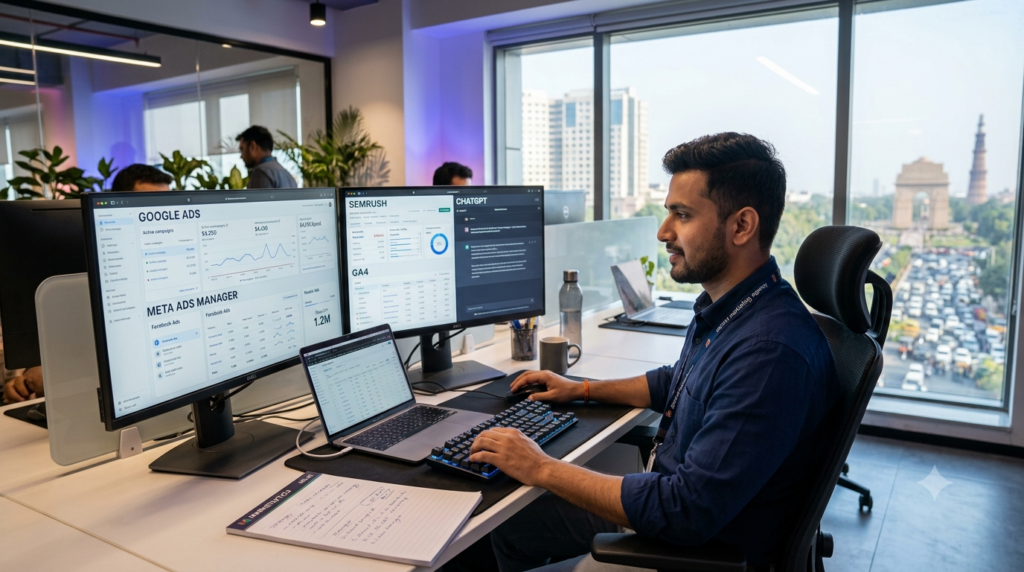
yes — but not for the reasons most digital marketing is booming articles tell you. If you’ve landed here, you’ve probably already read a dozen pages promising six-figure salaries and “work from anywhere” freedom. You’re right to be sceptical. This is the honest version: what the digital marketing career scope in India actually looks like in 2026, what you’ll realistically earn, who’s hiring, and where the genuine risks are — including whether AI is about to make the whole field redundant.
By the end you’ll be able to decide whether this is the right move for you, not for the influencer trying to sell you a ₹50,000 course.
What is the current demand for digital marketing professionals in India?
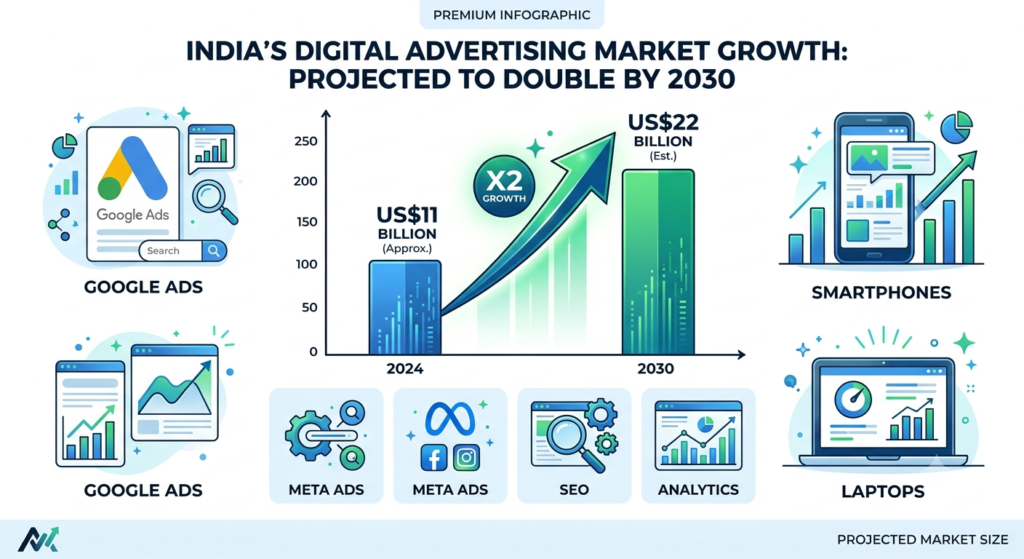
Demand is real, and it’s structural rather than hype. India’s digital advertising market is projected to nearly double to around US$22 billion by 2030, according to the [India Brand Equity Foundation (IBEF)](https://www.ibef.org/news/india-s-digital-advertising-market-is-projected-to-nearly-double-to-us-22-billion-by-2030). When ad budgets move online at that scale, someone has to plan, run and measure those campaigns — and that someone is a digital marketer.
It’s already happening, not a future promise. Digital media now accounts for roughly 46% of India’s ₹1,00,000 crore (≈US$11.4 billion) advertising market, per [IBEF, citing Crisil](https://www.ibef.org/news/digital-media-claims-46-of-india-s-rs-1-00-000-crore-us-11-41-billion-advertising-market-crisil). Digital has overtaken print and is closing in on television. Every rupee that shifts from a newspaper ad to a Meta or Google campaign is demand for people who understand performance marketing, SEO, content and analytics.
On the talent side, [LinkedIn’s Skills on the Rise 2026 for India](https://www.storyboard18.com/brand-makers/linkedins-skills-on-the-rise-2026-identifies-top-skill-stacks-reshaping-indias-workforce-90556.htm) lists digital and AI-driven marketing skills among the fastest-growing the platform tracks — a signal that employers are actively short of these skills, not flooded with them. That gap is exactly where digital marketing jobs in demand in India come from.
The honest caveat: demand is strongest for people who can prove they can run a campaign, not for people who merely hold a certificate. More on that below.
What salary can you expect: entry-level vs 3 years' experience?
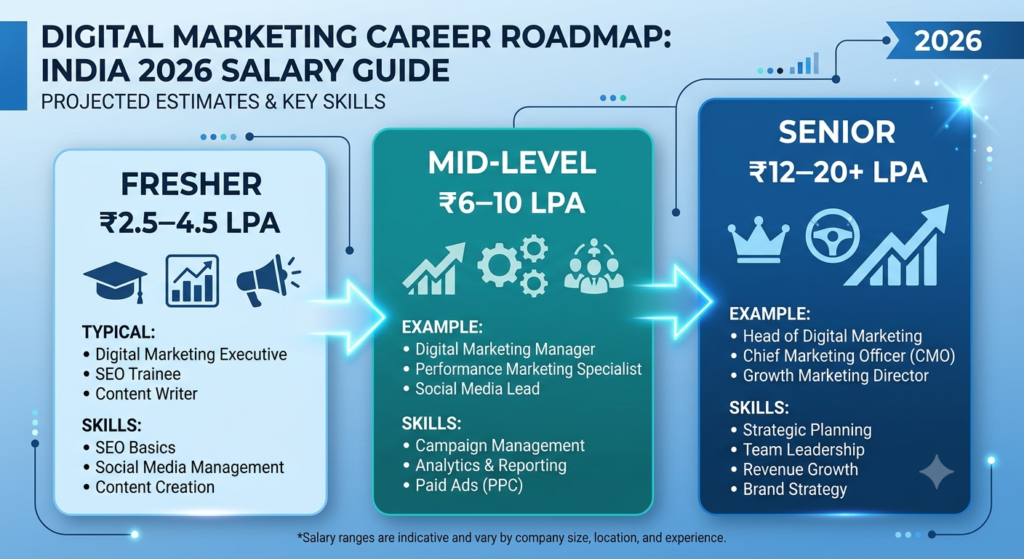
Here’s the realistic picture of digital marketing salary in India in 2026, based on aggregated industry salary reports (verify current ranges before quoting these as fixed):
– Entry-level (0–1 year): roughly ₹2.5–4.5 LPA (about ₹25,000–40,000/month). Notably, that’s already higher than many traditional fresher roles, which often start at ₹15,000–25,000/month.
– Mid-level (3–5 years): typically ₹6–10 LPA, with metro roles in Delhi, Mumbai and Bangalore at the upper end.
– Senior / managerial (5+ years): ₹12–20 LPA and above, with specialists in performance marketing and marketing analytics often beyond that.
Two honest points. First, the jump from entry to mid-level is driven by demonstrable results — a candidate who can show “I scaled this account from ₹1L to ₹5L/month at a 4× ROAS” earns far more than one who can only list tools. Second, location and specialisation matter more than your degree: a skilled performance marketer in Rajouri Garden, Delhi can out-earn a generalist with a fancier CV elsewhere.
Which industries hire the most digital marketers in Delhi NCR?
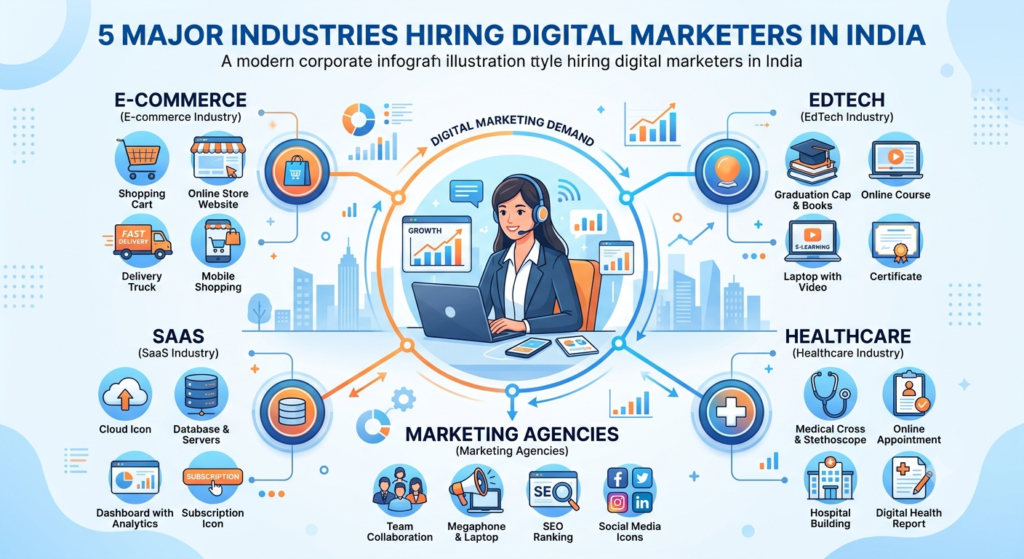
Delhi NCR is one of India’s densest hiring markets for digital roles, and demand clusters in a few fast-growing verticals:
– E-commerce & D2C brands — performance marketing and retention are core to their P&L, so they hire aggressively.
– EdTech — heavy paid-acquisition and content engines; a large NCR employer base.
– Healthcare & wellness — rapidly digitising patient acquisition.
– IT / SaaS services — demand-generation, SEO and marketing automation roles.
– Agencies — the fastest way for freshers to get *breadth* across many client accounts in a short time.
For someone based in West Delhi, the practical advantage is access: agencies and brand offices across Rajouri Garden, Connaught Place and Gurugram are commutable, and local institutes with placement networks plug you straight into that pipeline. (If you’re weighing structured training, our [Digital Marketing course in Rajouri Garden](/digital-marketing-course-in-rajouri-garden) is built around exactly this NCR hiring market.)
Is digital marketing better than a traditional marketing career?
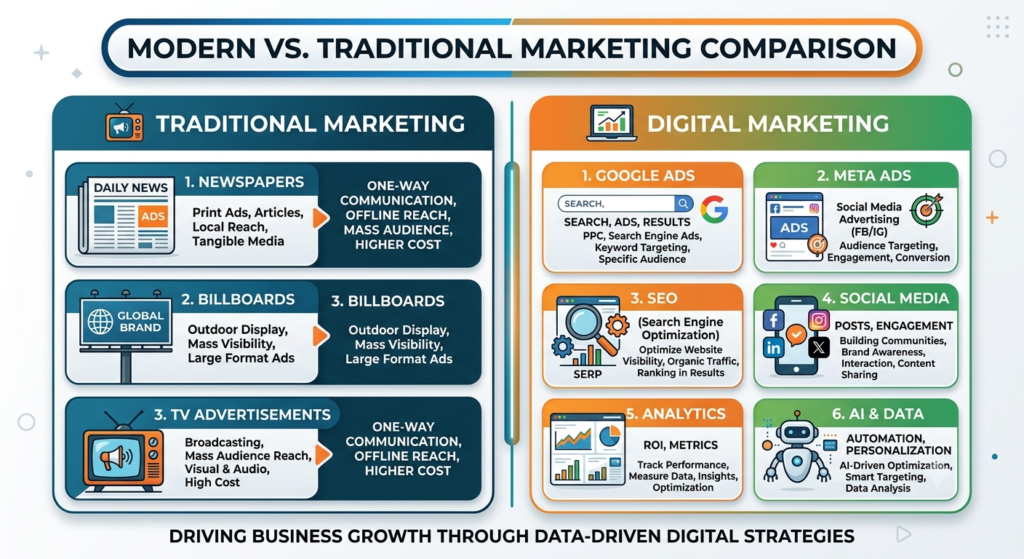
“Better” depends on what you want, but a few differences are objective:
– Speed of entry. Traditional marketing roles often gate on an MBA. Digital marketing is skills-first—a strong portfolio can get you hired without one.
– Measurability. Digital work is accountable to numbers (CTR, CAC, ROAS). That’s pressure, but it’s also how you prove value fast and get promoted.
– Lower entry cost. You can learn and practice with a laptop and small ad budgets; you don’t need to wait for a big brand to “give you a brief.”
– Optionality. The same skills work in a job, as a freelancer, or for your own venture.
The trade-off: traditional brand-marketing roles can offer deeper strategic and creative scope early on, and some legacy industries still prefer the MBA route. Digital marketing rewards people who enjoy continuous learning — the platforms change every quarter. If that sounds exhausting rather than exciting, be honest with yourself now.
What skills do you need to get a digital marketing job in India?
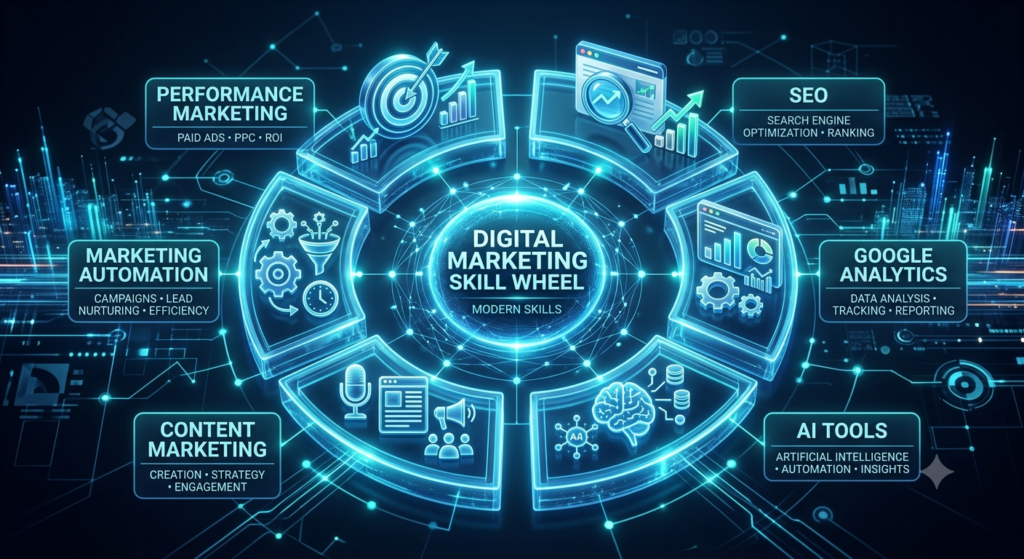
This is where most aspirants go wrong — they collect certificates instead of building proof. Employers in 2026 hire for:
1. Performance marketing — Google Ads and Meta Ads, with real budget-handling experience.
2. SEO & content — keyword research, on-page optimisation, and content that ranks.
3. Analytics — GA4, Google Tag Manager, and the ability to read data and act on it.
4. Marketing automation & email/CRM — basic funnels and lifecycle flows.
5. AI fluency — using tools like ChatGPT and AI ad features to work faster (a multiplier, not a replacement — see the next section).
6. A portfolio — live campaigns, a ranked blog, a managed social account, or a documented case study. This is the single biggest differentiator between candidates who get hired and those who don’t.
A structured program helps here only if it’s hands-on. Our [Digital Marketing course](/courses/digital-marketing) is built around live projects and current tools so you graduate with a portfolio, not just a certificate.
Is digital marketing a stable career, or will AI replace it?
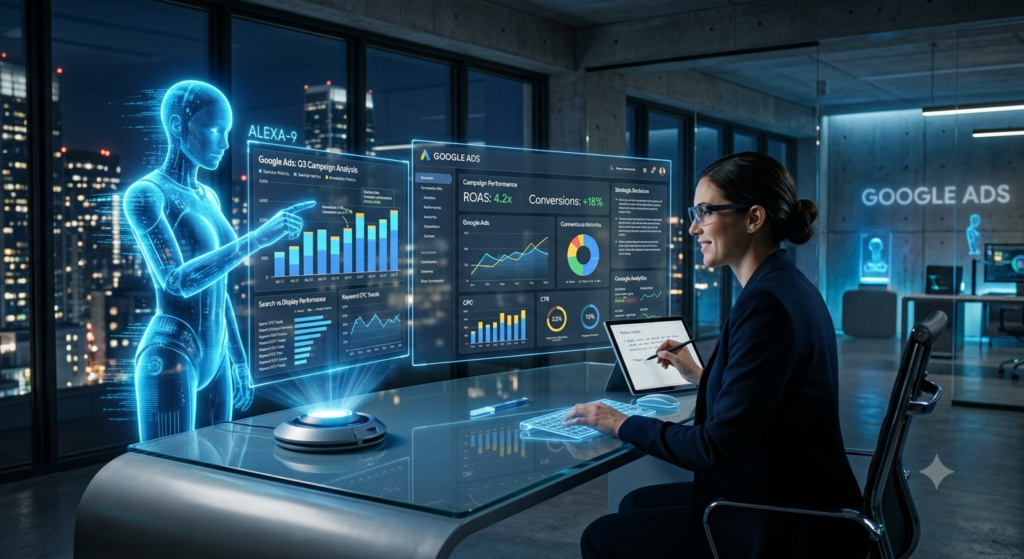
This is the real fear behind the future of digital marketing in India in 2026, so let’s be straight about it.
AI is automating the basic tasks — first-draft copy, routine reporting, basic creative variations, bid adjustments. If your entire skill set is “I can write a caption” or “I can pull a report,” that’s genuinely at risk.
But AI is also expanding the field. The same IBEF growth that’s pushing India’s digital ad market toward US$22 billion means more campaigns, more channels and more data than ever — and someone has to set strategy, judge creative, interpret AI output, and own the numbers. AI handles the repetitive 60%; humans own the 40% that decides whether a campaign actually makes money. The marketers at risk aren’t the ones using AI — they’re the ones who don’t.
So: stable, yes — but only if you keep levelling up. This is a field that rewards the curious and quietly retires the complacent.
The honest verdict
Digital marketing is a genuinely good career in India in 2026 — strong structural demand, fast skills-first entry, healthy salary growth, and real long-term scope. It is *not* a get-rich-quick shortcut, and it punishes people who stop learning. If you’re willing to build a portfolio, get comfortable with data, and use AI rather than fear it, the odds are firmly in your favour.
Frequently asked questions
1. Is digital marketing a good career for freshers in India?
Yes. It’s one of the few high-growth fields you can enter without an MBA — skills and a portfolio matter more than your degree. Entry-level roles typically start around ₹2.5–4.5 LPA and rise quickly with proven results.
2. What is the salary of a digital marketer in India?
Roughly ₹2.5–4.5 LPA at entry level, ₹6–10 LPA with 3–5 years’ experience, and ₹12–20 LPA or more at senior/managerial levels. Performance-marketing and analytics specialists tend to earn at the top of these ranges.
3. Are digital marketing jobs in demand in India?
Yes. India’s digital ad market is projected to nearly double to ~US$22 billion by 2030 (IBEF), and LinkedIn lists digital/AI marketing skills among the fastest-rising in the country — both signs of sustained hiring demand.
4. Will AI replace digital marketing jobs?
AI is automating routine tasks (basic copy, reporting, bid tweaks) but expanding the overall field. Marketers who use AI to work faster are in higher demand; those who rely only on basic, automatable tasks are most at risk.
5. Do I need a course to start a digital marketing career in India?
Not strictly — but a good hands-on course shortens the path by giving you live-project experience, current tools (Google Ads, Meta, GA4) and a portfolio employers trust. Self-learning works too if you’re disciplined about building real campaigns.
Not sure if digital marketing is the right career? [Book a free 30-min counselling call.] No pressure — just clarity on whether this path fits your goals