

Online vs offline digital marketing course: which is better?
There’s no universally “better” format — there’s only the format that fits how *you* actually work and learn. This post breaks down the real trade-offs across cost, discipline, networking and hands-on practice, so you can pick based on your own habits rather than whichever option a salesperson pushes harder.
The honest starting point: format doesn't decide the outcome, effort does
Before comparing, one caveat that applies regardless of what you choose: neither format compensates for a course with weak curriculum, no live projects, or no real placement support. A great offline course beats a mediocre online one, and a great online course beats a mediocre offline one. Pick the *institute* first using a proper checklist (see our [guide to choosing a digital marketing institute in Delhi] )— then decide the format.
With that said, here’s how the two genuinely differ.
Cost and commute

Offline courses carry an implicit cost beyond the fee: daily commute time and transport expense. If you’re based near the institute — say, within reach of Rajouri Garden Metro — this cost is small. If you’re commuting from across NCR, it adds up in both time and money, and commute fatigue is a real reason people drop off mid-course.

Online commute entirely, which is often the deciding factor for working professionals fitting classes around a job, or students juggling college alongside the course.
Discipline and accountability

This is where people are least honest with themselves.
Offline classes build in structure — you’re physically present, in a room, on a schedule you can’t quietly skip. For learners who know they need external accountability to stay consistent, this matters more than any other factor on this list.
Online demands more self-discipline. Live, instructor-led online batches (not pre-recorded videos) narrow this gap significantly, since you still have fixed class times and a visible instructor but you can still mute your camera and drift. Be honest about whether you’re someone who finishes what they start without someone watching.
Networking and peer learning

Offline classrooms create incidental networking — the person next to you might become a referral source, a collaborator, or just someone to compare notes with during a tough module. For freelancers and career switchers particularly, this informal network can matter as much as the curriculum.
Online networking is possible but has to be more deliberate — through group projects, community channels or instructor-facilitated introductions. It rarely happens by accident the way it does in a physical room.
Hands-on practice and tool access
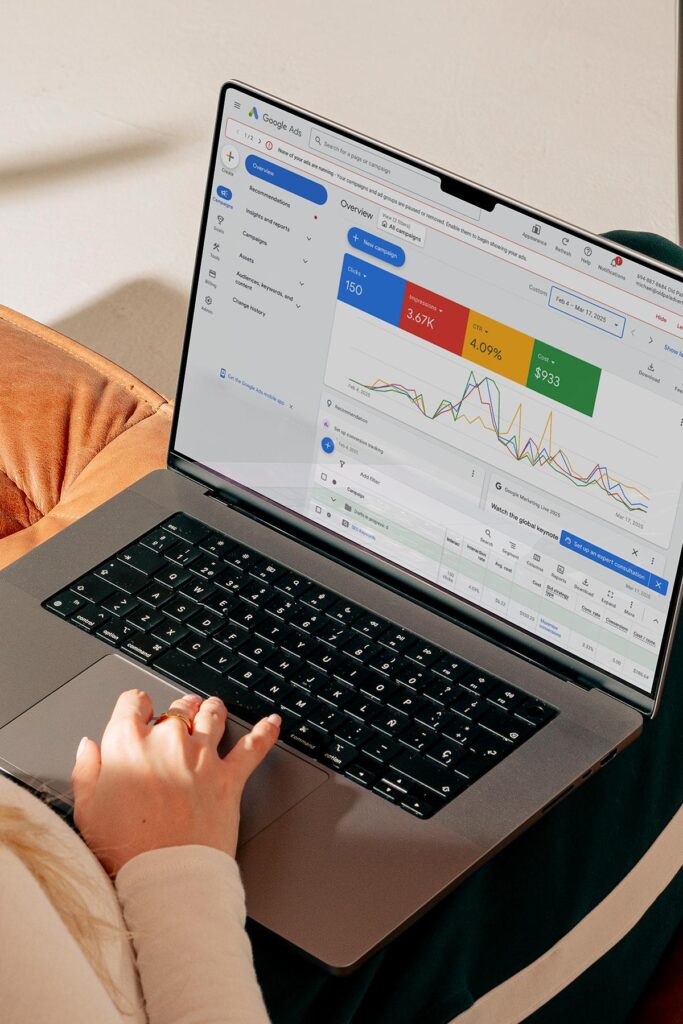
This is less about format and more about how the institute runs its labs — but the pattern generally holds:
Offline sessions typically make it easier for instructors to walk over and troubleshoot your screen directly, which speeds up debugging when a campaign setup or a tool isn’t working as expected.
Online, live instructor-led sessions with screen-sharing largely close this gap, especially for digital marketing (unlike, say, hardware-based training) since almost everything — Google Ads, GA4, SEO tools, AI tools — is cloud-based and equally accessible either way.
Doubt-clearing speed
Offline: doubts get cleared in real time, in the room, often before you’ve even finished asking the question.
Online: live sessions still allow real-time doubt-clearing via chat or voice — the difference is smaller than most people assume, as long as the batch is genuinely live and not a recorded-video format with delayed forum replies.
Flexibility

Offline is fixed — you show up when the batch runs, full stop.
Online batches are typically more flexible on rescheduling a missed class or catching a recording of a live session you couldn’t attend live. For people with unpredictable schedules — freelancers with client deadlines, professionals with variable shift timings — this flexibility can be the deciding factor.
Quick comparison

| Factor | Offline | Online (Live, Instructor-Led) |
|---|---|---|
| Commute Cost | Time and travel expenses required | No commute cost |
| Built-in Accountability | Strong classroom discipline and attendance | Moderate; requires self-discipline |
| Networking Opportunities | Natural face-to-face interactions | Possible, but requires proactive participation |
| Hands-on Tool Access | Excellent practical lab experience | Excellent via cloud-based tools and screen sharing |
| Doubt Clearing | Immediate, in-person support | Fast, provided classes are genuinely live |
| Schedule Flexibility | Fixed class timings | Greater flexibility; easier to catch up if you miss a class |
Who should choose which

– Choose offline if: you’re within a reasonable commute, you know you need external structure to stay consistent, and in-person networking matters to your goals (e.g. you want an internship referral pipeline).
– Choose online if: you’re a working professional or student with a tight or unpredictable schedule, you’re outside comfortable commuting distance, or you’re already disciplined enough to treat a live online class with the same seriousness as an in-person one.
– Consider a hybrid option if it’s available — some institutes let you mix classroom sessions with live-online catch-ups, giving you the accountability of offline with the flexibility of online when life gets in the way.
The trap to avoid: choosing based on price alone
A cheaper “online-only” course is not automatically the better financial choice if you’re the kind of learner who needs a room and a deadline to actually finish. Unfinished courses are the most expensive kind — you’ve paid the fee and gained nothing. Choose the format you’ll actually complete, not the one that looks cheapest on paper.
Frequently asked questions
1. Is an online digital marketing course as effective as an offline one?
Yes — provided it’s live and instructor-led, not pre-recorded videos. Since almost all digital marketing tools (Google Ads, GA4, SEO platforms, AI tools) are cloud-based, hands-on practice quality is comparable across both formats. The main differences are accountability structure and networking, not learning quality.
2. Which is cheaper — online or offline digital marketing courses?
Course fees themselves are often similar for the same curriculum; the real cost difference is commute time and transport for offline students. Factor in your actual commute cost before comparing on fee alone.
3. Can I switch between online and offline batches mid-course?
This depends entirely on the institute — ask specifically before enrolling if you think your circumstances might change (e.g. a job relocation) during the course.
4. Is offline better for beginners with no marketing background?
Not necessarily — what matters more for beginners is the practical-to-theory ratio and how much individual mentor attention you get, both of which can exist in either format if the batch sizes are small.
5. Do employers care whether I studied online or offline?
No. Employers evaluate your portfolio, live-project experience and interview performance — not which format you studied in. Focus your format decision on what helps you actually finish and build that portfolio.
Not sure which format fits you?UpskillNexus runs both classroom batches (Rajouri Garden) and live, instructor-led online batches for the same CDMS curriculum — [see the course details]and book a free demo class in either format to try before you decide.