
AI-Powered Copywriting: Why Human Creativity Still Wins

Artificial Intelligence has transformed the way we create content.Tools like Jasper, Copy.ai, and ChatGPT now generate ad copies, captions, and landing page text in seconds, a task that once demanded hours of brainstorming. But as brands race toward automation, a crucial question emerges:Can AI truly capture human emotion or just simulate it? Let’s break it down through what, why, and how exploring where AI excels, where it falls short, and how smart marketers can merge both worlds effectively. The Rise of AI-Powered Copywriting AI copywriting tools have moved far beyond grammar correction or keyword suggestions. Today, they use large language models (LLMs) to mimic tone, structure, and intent based on prompts producing everything from social media posts to product descriptions. For marketers, this shift has unlocked: Speed: Copy in seconds, not hours. Scalability: Bulk campaign generation without creative fatigue. Cost Efficiency: Reduced dependency on large content teams. Platforms like Jasper focus on tone-adaptive marketing copy, Copy.ai streamlines short-form ad messaging, and ChatGPT enables conversational, context-driven writing.These tools are not just assistants, they’ve become the new baseline for productivity. Why Human Creativity Still Wins Despite its progress, AI remains pattern-driven, not purpose-driven.It can generate polished sentences, but it lacks empathy, cultural awareness, and lived experience, the cornerstones of truly resonant storytelling. The Emotional Pulse Problem AI understands what people say, not why they feel it.For instance, an AI-generated ad for a mental health app may emphasize “self-care routines,” while a human writer instinctively connects to loneliness, identity, and recovery emotional triggers that drive real impact. Case Example: In 2024, a European wellness brand A/B tested two ad copies one by Jasper, one by a human writer. The AI version focused on features (“Track your mood daily, build better habits”). The human version focused on empathy (“You don’t have to feel alone in your bad days”). The human-written version outperformed AI’s by 63% in engagement and 41% in conversions. Context and Cultural Sensitivity AI models are trained on large global datasets, but they lack real-time understanding of local nuance or social sentiment. This can lead to tone-deaf campaigns or misaligned messaging especially in culturally diverse markets like India. Example: Copy.ai once suggested a festive caption for Diwali with fireworks emojis and “celebrate the lights” missing the ongoing public discourse around pollution and sustainability. A human marketer, aware of local sentiment, reframed it as “Celebrate light, not smoke make this Diwali brighter responsibly.” Same intent, entirely different impact. Brand Voice Consistency AI-generated content often fluctuates in tone across prompts. Humans, however, intuitively maintain brand storytelling continuity understanding the brand’s persona, audience psychology, and subtle tonal differences between platforms. Hybridizing AI and Human Creativity The future of copywriting isn’t about choosing between AI and humans, it’s about collaboration. AI amplifies productivity; human creativity anchors authenticity. Let AI Handle the Structure, Humans Handle the Soul Use AI for: Drafting frameworks, headlines, and outlines. Ideation — generating 10 starting points fast. Grammar, paraphrasing, and SEO optimization. Let humans: Add emotion, brand depth, and storytelling flair. Adapt tone for audience segments. Integrate sensory and cultural cues that AI cannot infer. Humanize Before You Publish Before finalizing AI-generated text, perform a “human empathy audit.” Ask: Does this copy evoke emotion or just information? Does it sound like something a person would say, not type? Would it make sense to someone outside the marketing bubble? Build an AI-Human Workflow A simple hybrid workflow for agencies and teams: Prompt Stage: Use AI for draft generation. Human Edit: Refine tone, intent, and emotional layer. Testing: A/B test both versions — data decides what resonates. Learning Loop: Feed high-performing human-edited versions back into the AI system for improved future prompts. AI Writes, Humans Connect AI-powered tools have redefined the how of copywriting making content creation faster, data-driven, and more accessible. But human intuition remains the heartbeat of persuasive writing. The brands that will stand out in 2025 aren’t those that fully automate but those that strategically humanize automation. The winning formula:AI for efficiency. Humans for empathy. Together, for impact.
WPP × Google’s $400 Million AI Collaboration: What It Means for Future Marketers
In October 2025, WPP, one of the world’s largest marketing and advertising agencies, announced a landmark five-year partnership with Google, committing US$400 million to adopt and integrate Google’s AI and cloud technologies. This collaboration goes beyond technology adoption; it represents a strategic shift in how marketing campaigns, data, media, and creative production will operate in the coming years. For marketers, understanding the implications of this partnership is critical to staying competitive and future-ready. This article breaks it down into what the deal involves, why it matters, and how marketers should prepare. What the WPP–Google Collaboration Involves Financial Commitment: WPP will invest $400 million over five years in Google Cloud and AI services. Access to Advanced AI Tools: WPP gains early access to Google’s generative AI models (like Gemini, Imagen, Veo) and integrates them into WPP’s marketing technology stack, called WPP Open. Global Integration: The partnership spans all aspects of WPP’s operations from creative production and media planning to personalisation, commerce, and campaign analytics. Operational Goals: Automate repetitive tasks, speed up campaign production, improve data-driven personalisation, and allow real-time optimisation of creative and media. In essence, WPP plans to embed AI into every step of the marketing process, from ideation to delivery. Why This Partnership Matters for Marketers Campaign Speed and Efficiency Traditional campaigns, especially those running across multiple countries or markets, can take weeks or months to execute. AI integration allows WPP to shorten production cycles and launch campaigns faster. Implication for marketers: Teams need to adapt to faster workflows and more agile decision-making processes. Personalisation at Scale AI enables the creation of highly tailored campaigns for individual audiences. This goes beyond segment-level targeting to potentially delivering unique creative messaging, and offers to millions of customers simultaneously. Implication for marketers: Data management and audience segmentation become central. Marketers must leverage first-party data and consent-based targeting strategies. Creativity Reimagined Generative AI allows brands to quickly produce images, video, and copy variations. This means creative teams can focus on strategy, storytelling, and brand messaging while AI handles scale and variation. Implication for marketers: Creativity now involves blending human insight with AI-driven content generation. Skills and Workforce Evolution The deal highlights the need for hybrid skill sets marketers who understand AI, data analytics, and technology as well as traditional creative strategy. Implication for marketers: Upskilling teams and training in AI and cloud technologies will become essential. Competitive Advantage Brands partnering with agencies leveraging advanced AI tools are likely to gain speed, efficiency, and personalisation advantages. Those who stick with traditional methods may fall behind. Implication for marketers: Adoption of AI isn’t optional; it is increasingly a factor in competitiveness. How Marketers Should Prepare Here are concrete steps for marketers to align with the AI-driven future: Audit Your Technology Stack Identify tools and processes that can be enhanced by AI. Look for ways to automate repetitive tasks such as creative resizing, copy variation, or media reporting. Strengthen Data Practices Clean first-party data is critical for AI-driven personalisation. Ensure robust consent management and compliance with data privacy regulations. Invest in tools that allow real-time data insights and audience segmentation. Upskill Your Teams Train staff in AI tools, analytics, and cloud-based marketing platforms. Encourage learning in hybrid roles combining creative and tech skills. Reimagine Creative Processes Move from one-size-fits-all creative to modular, adaptable content. Use AI to generate multiple versions of creative assets for different audiences, channels, and regions. Embrace Experimentation and Real-Time Measurement Launch campaigns more frequently and test variations at scale. Monitor performance in real time, optimize based on audience response, and iterate quickly. Partner with the Right Agencies and Platforms Evaluate if your current agencies can integrate AI efficiently. Consider partnerships with vendors offering AI-based media, creative, and analytics solutions. Implications for the Future Marketing will become faster, smarter, and more personalized. Data-driven creativity will replace guesswork and repetitive manual processes. Hybrid skill sets will be in demand marketers must blend creativity, technology, and analytical thinking. Agencies and brands that embrace AI will have a strategic advantage in audience engagement, efficiency, and ROI. In short, AI is no longer just a support tool it is becoming a core driver of marketing strategy. The WPP–Google $400 million partnership is a clear signal that the future of marketing is AI-driven. For marketers, this is both an opportunity and a challenge. Those who understand, adopt, and integrate AI into their workflows will lead, while those who delay risk falling behind. The key question is not whether AI will change marketing, it’s how prepared you are to use it effectively.
Smishing & Blockchain: The New Attack Vector

Cyberattacks are becoming more advanced, and criminals are always searching for new ways to target people. Recently, cybersecurity analysts uncovered a large international campaign involving more than 194,000 malicious domains. These domains were used to send fake text messages, known as smishing attacks, and trick victims into revealing their information or allowing unauthorized access to their crypto wallets. This blog explains what this threat is, why it matters, and how you can protect yourself. What is Smishing? Smishing is a form of phishing conducted through SMS or messaging apps like WhatsApp, iMessage, or Telegram. The attacker sends a message that appears to come from a trusted organization such as a bank, a courier service, a government agency, or a crypto platform. The message usually contains a shortened or misleading link and creates a sense of urgency, such as: “Your bank account will be blocked. Verify now.” “You have an unpaid toll. Pay immediately.” “You have a pending reward in your Solana wallet.” When the user clicks the link, they are taken to a fake website designed to steal their login details, payment information, or wallet access. How Blockchain Became the New Target Cybercriminals have realized that targeting cryptocurrency users can lead to immediate and high-value payouts. Blockchain networks like Solana and major exchanges are increasingly being impersonated through: Fake airdrop websites Fraudulent wallet connection pages Deceptive token reward alerts Phishing sites that request seed phrases Once a criminal gains access to a user’s wallet, they can transfer funds instantly. Since blockchain transactions are irreversible, there is no way to recover stolen money. The combination of smishing and blockchain fraud creates a powerful attack method: the mobile message delivers the trap, and the crypto scam executes the theft. Why This Attack is Growing There are several factors contributing to the rapid increase in smishing-based blockchain attacks: More people are using digital wallets on mobile phones. Cryptocurrency is valuable and easy to transfer without oversight SMS messages are seen as more trustworthy compared to email. Festival seasons and promotional periods make users more likely to click offers. Attackers now have access to tools that automatically create thousands of fake websites quickly. In other words, the more convenient mobile finance becomes, the more attractive it becomes to cybercriminals. How These Attacks Actually Work Although attacks may look different on the surface, the core process is similar: The attacker sends a believable message using a fake link. The victim clicks the link, thinking it is legitimate. The website asks the victim to log in, update information, or connect a wallet. The attacker captures credentials or triggers a harmful transaction. Funds, identity data, or personal access is stolen. A single click can result in complete loss of personal or financial security. How to Stay Protected Avoiding these attacks requires awareness and strong security habits. For all mobile users: Do not click links in SMS if the sender is unknown or suspicious. Access services directly through official apps or websites. Do not respond to messages asking for passwords, OTPs, or personal information. Update your phone and apps regularly to remove security weaknesses. Report and block unwanted or scam messages. For cryptocurrency users: Never share your seed phrase, private keys, or recovery codes. Verify website URLs before connecting your wallet. Reject wallet transaction requests you do not understand. Use hardware wallets for storing large amounts of crypto. Review your connected applications and remove unnecessary permissions. The combination of smishing and blockchain scams represents a powerful new cyberattack trend. Criminals know that people rely heavily on their phones for payments, banking, and managing digital assets. By targeting the one device we trust the most, attackers increase their chances of success. However, with the right knowledge and cautious behavior, these threats can be avoided. Take time to verify every message, especially those involving money. Cybersecurity is no longer optional; it is a necessary life skill. If you are aware, you are already ahead of the attack.
November 2025 Summary: How Digital Marketing, Cybersecurity, and AI Revolutionized the Tech Industry

November 2025 wasn’t just another month in tech; it was a turning moment. Artificial intelligence reached its fastest update cycle in history, cybersecurity concerns soared with AI-driven attacks, and digital marketing fully entered the era of hyper-personalization. With sophisticated government initiatives, a rise in the use of AI tools, and an increase in digital commerce activities, India also had a significant impact. Let’s go into everything that shaped November 2025 across AI, cybersecurity & digital marketing, with extensive explanations. Artificial Intelligence: The Fastest Month in AI History This month was unlike anything the AI world had ever seen. Three major model releases, massive infrastructure investments, and next-gen AI agent tools changed how people and businesses use technology. Groundbreaking AI Model Releases OpenAI GPT-5.1 (Released November 13) GPT-5.1 quickly became the most capable AI model for real-world automation. Here’s why: What made GPT-5.1 special? Adaptive Thinking Engine: This system allows ChatGPT to behave like a human assistant. It replies instantly to simple questions. It “thinks deeply” only when tasks demand complex reasoning. This removed unnecessary delays and improved productivity across industries. Two Thinking Modes Instant Mode → Perfect for daily tasks, social media content, CRM replies, quick notes, and basic calculations. Deep Thinking Mode → High-level reasoning for coding, research, legal writing, data analysis, and strategy. Better Coding & Debugging Developers reported that GPT-5.1 solved bugs more quickly and accurately understood large codebases with fewer errors. It improved software development speed dramatically. apply_patch Feature For the first time, users could ask the AI to automatically: Add new features to the code Rewrite documents Fix bugs Modify files without manual editing This revolutionized programming and content creation. Larger Prompt Caching GPT-5.1 remembers big project contexts for longer. Teams using AI for workflows (CRM, email automation, SEO research, content plans) saved up to 40% of costs. Anthropic Claude Opus 4.5 (Released November 25) Claude Opus 4.5 became the most trusted enterprise AI model. Why enterprises loved Opus 4.5: 80.9% SWE-Bench Score This benchmark measures a model’s ability to solve real GitHub coding issues. Scoring 80.9% made Opus 4.5 the most accurate coding AI ever. Superior Long-Context Understanding Opus can analyze long documents (contracts, legal files, insurance policies) without losing context. This made it essential for: Lawyers Banks Research institutions Policy creators Deep Safety + Prompt Injection Protection Companies dealing with sensitive information preferred Claude because it follows strict safety and compliance. Consistent Decision-Making While GPT-5.1 is creative and fast, Opus 4.5 became the “serious model” for enterprises. Perfect for auditing, compliance, risk analysis, and financial operations. Google Gemini 3 (Released November 18) Gemini 3 emerged as a multimodal powerhouse. What made Gemini 3 stand out? 1501 Elo Score Elo is a performance rating. Crossing 1500 meant Gemini 3 outperformed other models in reasoning tasks. Real-time Audio, Video & Image Understanding Gemini 3 can: Understand videos frame-by-frame Analyze audio in real time React to images instantly Creators and educators loved this because they could generate content faster. Full Integration with Google Workspace Gemini became part of: Docs Sheets Slides Gmail Drive Making entire workflows AI-assisted. On-device AI Optimization Phones and tablets started running powerful AI models locally using less internet data. This boosted adoption drastically. AI Tools Dominating November – New AI Tools Launched: Google Antigravity IDE A next-gen coding environment: Auto-debug AI-native code generation Multi-agent workflows Automated documentation Developers can build apps faster than ever. – Microsoft Agent 365 AI agents inside office tools like Excel Word PowerPoint Teams These agents automate entire departments—finance, HR, marketing. – Meta SAM 3 An advanced video segmentation tool. Filmmakers and creators can isolate objects in videos automatically. Pixel Drop AI Features Scam call detection Real-time photo editing Instant object removal This boosted security and creativity. Digital Marketing: The Rise of AI-First Personalization November 2025 changed digital marketing forever. AI personalization is now the default. Google & Platform Updates Google Demand Gen, Holiday Update This was the biggest update for advertisers: Features Explained: AI Image → Video Conversion: Upload an image, and Google turns it into a short AI video ad. Expanded YouTube Placements Ads now appear on: Shorts Smart TVs Discover feeds This increased brand reach. AI-Optimized Ad Assets Google auto-generates: Headlines Visuals CTA variations Brands saw 30–60% higher engagement. Shopping visuals via AI products now appear in 3D, lifestyle formats, or auto-generated images. ChatGPT Shopping Research A game-changer for e-commerce SEO. AI now helps shoppers: Compare products Analyze reviews Rank items by value Show pros & cons Suggest alternatives Businesses now optimize for “AI search,” not just Google. Adobe Acquires Semrush for $1.9B This created the world’s most powerful SEO + content + Creative Cloud ecosystem. Marketers can now generate: SEO-optimized blogs Content calendars Competitor analysis Social media content Inside one unified interface. Organic SEO Shift, AI Overviews Explained Google’s AI Overviews changed SEO rules completely. What happened? People got answers directly on Google → fewer website clicks. CTR dropped by 61% for many niches. Keywords matter less; questions + solutions matter more. What brands did next: Optimized content for conversational queries Built content for “zero-click SEO” Added more FAQs Focused on authority, trust, and long-form content SEO is now more about expertise, less about keyword stuffing. Major Social Media Updates, Explained Instagram AI Photo Editor—one-tap retouching, object editing Magic Expand for Reels—expands the background instantly Voice-to-Reel Auto Sync—perfect for creators AI Stickers—fully customizable Scheduled Reels + Captions—great for brands Instagram is turning into a full AI-editing platform. Facebook AI Messenger Assistant in India—helpful for customer support Auto-generated ad creatives AI Quick Replies for Pages Better Reel Editing Small businesses benefit the most from these. YouTube AI Summaries—help viewers preview videos. Auto Shorts—long videos → short vertical content. E-commerce Ad Expansion Brands get better conversion opportunities. Cybersecurity, One of the Riskiest Months of 2025: Cybercrime grew massively due to AI-generated malware and phishing. Major Global Cyberattacks Oracle E-Business Suite Zero-Day (CVE-2025-61882) A zero-day vulnerability exposed employee data in multiple large organizations: Impacted: GlobalLogic
Offense Is the Best Defense: Why Ethical Hackers Are the New Security Leaders

For decades, cybersecurity was about defense. Build walls, monitor traffic, stop intrusions and a constant game of reaction. But in 2025, that strategy isn’t enough. The battlefield has changed. Cyberattacks today are faster, automated, and AI-powered striking before teams even know they’re under threat. That’s why a new kind of professional is leading the charge of ethical hackers. They don’t just defend networks, they attack them first to find weaknesses before real criminals do. This shift from reactive defense to proactive offense is reshaping the cybersecurity world. And it’s creating one of the most in-demand, future-proof career paths of the decade. How Cyberattacks Have Evolved Cyberattacks used to be predictable: a phishing email here, a virus there. But those days are long gone. Today’s threats are dynamic, invisible, and coordinated. Ransomware groups now operate like businesses, offering “attack kits” to anyone willing to pay. Deepfake voice scams are tricking CEOs into transferring millions. AI-driven malware can rewrite its code to evade detection. According to (ISC)², there’s a global shortage of over 4 million cybersecurity professionals and organizations are scrambling to fill the gap. In India alone, the demand for ethical hackers has grown by over 40% year-on-year as businesses digitize faster than ever. The result? Companies don’t just need people who can respond to cyberattacks, they need experts who can anticipate and outsmart them. What “Offensive Security” Really Means The phrase offensive security may sound aggressive, but in cybersecurity, it’s a smart, ethical, and strategic practice. Instead of simply waiting to detect attacks, offensive cybersecurity involves simulating real-world hacks to test how strong an organization’s defenses truly are. This is where the concept of Red Teaming comes in. In simple terms: The Red Team plays the attacker — attempting to breach systems using real hacking techniques. The Blue Team defends, monitors, and mitigates. The Purple Team bridges the gap — learning from both sides to strengthen strategy. This process helps organizations understand their blind spots and strengthen weak links before cybercriminals exploit them. Companies like Google, Microsoft, and even government agencies now employ dedicated red teams that conduct mock cyber wars not for chaos, but for preparedness. And that’s exactly the mindset the next generation of cybersecurity leaders need to master. The Mindset of an Ethical Hacker Becoming an ethical hacker isn’t just about learning tools it’s about developing a mindset. An ethical hacker thinks like a criminal, acts like a detective, and protects like a strategist. They ask questions that most people overlook: Where could this system break? If I were the attacker, what would I target first? How fast could I detect and fix the breach? They see patterns others miss. They explore vulnerabilities not to exploit, but to strengthen. What sets them apart is curiosity. They experiment, fail, and learn building intuition around how digital systems behave under pressure. And that curiosity pays off with cybersecurity salaries averaging ₹6–12 LPA for entry-level roles and rapidly scaling beyond ₹20 LPA for skilled ethical hackers in India. But more importantly, ethical hackers are emerging as decision-makers. They advise on risk frameworks, conduct audits, and build long-term security roadmaps leading organizations from the front. Inside the Red Team Advantage Modern cybersecurity learning isn’t theoretical anymore. It’s hands-on, live, and simulation-driven. Red Team Operator training programs like those offered by leading institutes immerse learners in real-world attack labs where they: Simulate breaches in controlled environments. Learn tools like Metasploit, Burp Suite, Wireshark, and Nmap. Conduct vulnerability assessments and penetration testing (VAPT). Execute phishing simulations, network exploits, and privilege escalations ethically. Collaborate in red vs. blue scenarios that mirror enterprise-scale operations. This blend of technical precision and strategic foresight creates professionals who can both break and build the ultimate skillset in modern cybersecurity. Offensive training isn’t about chaos; it’s about control through understanding. Once you learn how attackers think, you become ten times better at defense. From Defenders to Leaders The shift toward offensive cybersecurity isn’t just a skill trend, it’s a leadership evolution. Tomorrow’s Chief Information Security Officers (CISOs) and cybersecurity consultants will come from offensive security backgrounds, because they understand every angle of the threat landscape. They don’t rely on dashboards or alerts; they design systems that are inherently resilient. They don’t wait for a breach, they simulate one before it happens. This proactive, predictive approach is transforming how businesses approach digital trust. In a world where every company is a tech company, cybersecurity isn’t just IT it’s strategy. The Future Belongs to the Proactive Cybersecurity isn’t just about protection anymore. It’s about anticipation. AI, automation, and connected systems have created a new kind of battlefield one that rewards those who can think two steps ahead. Ethical hackers, red team operators, and cybersecurity analysts who adopt this offensive mindset are becoming the new security leaders shaping not just how systems are defended, but how they are designed. In 2025 and beyond, the best cybersecurity professionals won’t be the ones who react to attacks. They’ll be the ones who saw them coming. Because in the digital world, offense truly is the best defense.
The Next-Gen Agentic Development Platform Developers Have Been Awaiting: Google’s Antigravity IDE
There is no doubt that the software development industry is undergoing a rapid transformation, and Google has explicitly declared that it has a place in the competition for state-of-the-art AI coding tools by introducing Antigravity Google. A powerful new agentic development platform for front-end engineers, full-stack developers, and professional developers is presented as Google Antigravity. This integrated development environment (IDE) is not only a competitor to Visual Studio Code but also encompasses Google’s concept of the “agent-first” epoch in which smart AI agents will be cooperating with developers, performing tasks that are normally done by humans, and producing applications that are deployment-ready in a much shorter time than before. Antigravity enables developers of all skill levels to utilize advanced, smooth, and efficient coding tools. And the best part? It is entirely free of charge. What Is Google Antigravity? Google Antigravity is an advanced IDE specifically for building agentic AI, that is, it is designed to be used for the development of agents by giving them some form of autonomy or control. It features: AI-powered coding agents Control centers Real-time user interface integration Browser-based feedback loops Support for full-stack, front-end, and professional workflows Think of it in the way of the evolution of traditional IDEs like VS Code, Cursor, or JetBrains, but now with AI agents co-working with you for coding, debugging, and task management purposes. Important Features and Highlights Ultimate IDE for Agentic AI In a confident turn, Google brings Antigravity as a competitor to IDEs like VS Code and Cursor: Agents’ Mission Management Through Antigravity’s mission control surface, developers are able to: Watch agents that work in the background Perform automatic code evaluation Give out tasks and track outcomes Reduce manual work significantly The process of coding is more like leading a group rather than doing the dirty work since agents take care of the boring job while you deal with logic, architecture, and creativity. Utilizing Google’s Gemini Models The most recent AI models from Google, Gemini 3 and Gemini 5, significantly enhance: performance speed logic Long-context coding handling tasks in multiple steps Antigravity is a sophisticated AI-powered IDE for developers that makes extensive use of these models. Decreased Context Switching Rather than switching between documents, tabs in a browser, and editors, Antigravity: streamlines processes in parallel controls knowledge inside the IDE permits agents to operate “behind the scenes.” This helps developers stay focused and saves time. Google Provides Free Advanced Tools Among the greatest surprises? Google is providing robust AI tools at no cost, such as: Gemini 3 Pro Code in the Cloud Tools for real-time UI feedback Antigravity is therefore perfect for students Novices Independent developers Startups Anyone interested in learning without having to pay a subscription fee Integration of Real-Time UI Changes are instantly visible to developers in the browser, which greatly enhances: UI design front-end processes troubleshooting user interactions Different Modes of Development Agent-driven development, in which agents do the majority of the work. Agent-assisted development: you maintain control while receiving AI assistance A Well-Known, Developer-Friendly Interface For developers accustomed to Visual Studio Code, Google Antigravity’s interface is comfortable. Among the features are: Explorer for files Support for multiple projects Chat panel for agents Templates for projects Rich code editor Advanced features in a free version The most impressive part, perhaps? A chat-style agent is integrated right into the IDE. This implies: obtain inline recommendations Request clarifications Request reviews of the code Create tests right away Strong Coding Agents With Inline Editing Antigravity’s coding agents are capable of much more than just producing snippets. They provide: inline editing management of tasks Suggestions for improvement directed changes to the code Orchestration of multiple agents This makes the coding environment more structured and expert, particularly for: ongoing projects deep research assignments cooperative processes Support for Extensions For instance, the Python extension Python tools for Microsoft Additional language integration Due to this, Antigravity can be utilized in a variety of programming environments. Support for Python and Quick Setup Installing Python within Antigravity enables you to: Execute code immediately control dependencies quickly create backend systems Extra advantages include a familiar terminal interface (like GitHub Copilot). quick project creation smooth code committing execution of commands in real time Constructing a FastAPI Calculator as a Basic Example The video shows how simple it is to use FastAPI to create an application. Highlights of the process: start a new project. Create several backend routes. launch the development server. Test in the browser right away. FastAPI is renowned for its speed. contemporary style async capabilities experience with clean development This example demonstrates how quickly full-stack apps can be developed within Antigravity. Although it’s not flawless yet, the user interface is quick, easy to use, and developer-friendly. The Significance of Google Antigravity Antigravity is marketed by Google as a professional-level AI IDE. An agent-first development platform An environment in which humans and AI agents co-code A complimentary toolkit when rivals are compensated This makes advanced development accessible to everyone and democratizes powerful tools. Conclusion Google Antigravity is the beginning of a new era in software development, not just an IDE. An era in which developers and agents work together Coding gets smarter and faster. Real-time UI feedback Workflows are optimized Tools are available and free. This is one of the most crucial AI-powered IDEs to investigate in 2025, regardless of your level of experience as an engineer.
The Cybersecurity Talent Gap: Why Now Is the Best Time to Enter the Field
Every time you read about a data breach, ransomware attack, or phishing scam, there’s one question behind the headlines that rarely gets asked: Who’s protecting the systems behind the screen? The truth is not enough people. As cyber threats surge across industries, the world is facing a massive shortage of trained cybersecurity professionals. And for anyone considering a future-proof, high-growth tech career, that shortage is actually an opportunity waiting to be claimed. The State of Cybersecurity Hiring in 2025 In 2025, the global cybersecurity workforce gap crossed 4 million professionals (according to the ISC² Cybersecurity Workforce Study). India alone needs over 500,000 trained cybersecurity experts to meet its rising digital security demands. This surge isn’t theoretical. Every new fintech app, digital bank, AI startup, and cloud-based enterprise creates new vulnerabilities and a need for someone who can protect them. Cybersecurity has moved from being an IT niche to a national priority. In fact: India’s cybersecurity market is projected to reach ₹70,000 crore by 2030 (source: NASSCOM). The average salary of a cybersecurity analyst has grown by over 25% in the past three years. Entry-level roles start at ₹5–7 LPA, while experienced professionals can earn ₹20–30 LPA+, depending on specialization. The demand is so high that, globally, for every two cybersecurity roles, only one qualified person exists. That means if you start now, you’re entering an industry actively looking for you. Why Companies Can’t Find the Right Talent It’s not that graduates aren’t interested in cybersecurity, it’s that most aren’t job-ready. Traditional IT programs focus heavily on theory, network layers, encryption algorithms, security protocols but rarely on what actually happens during a cyberattack or how to defend in real-time. Recruiters today face a dilemma: thousands of applicants, but very few who can: Identify and mitigate real vulnerabilities. Work with ethical hacking and penetration testing tools. Analyze logs and detect anomalies. Respond to live incidents or simulate attacks. In cybersecurity, knowledge isn’t enough. You need hands-on experience, the kind that comes from labs, simulations, and guided mentorship. What Skills Make You Employable in Cyber Roles Employers aren’t just looking for “ethical hackers.” They need professionals who understand systems end-to-end and can think like attackers to defend like experts. Some of the most in-demand cybersecurity skills in 2025 include: Network Security & Firewalls – Protecting systems from unauthorized access. Penetration Testing – Simulating real attacks to find vulnerabilities before hackers do. Incident Response – Managing breaches, tracing intrusions, and minimizing damage. Cloud & Application Security – Securing SaaS, AWS, and enterprise applications. Security Operations (SOC) Monitoring – Detecting threats in real time. AI & Automation in Security – Using AI tools for predictive threat analysis and rapid detection. And the best part? You don’t need to be a coder to start. With structured learning and guided labs, anyone with analytical thinking and curiosity can build these skills from scratch. How UpskillNexus Builds Industry-Ready Professionals At UpskillNexus, the goal is clear to turn learners into industry-ready cybersecurity professionals. The cybersecurity program is built on three pillars: Practical Labs Over Lectures – Every learner practices in simulated environments where real-world attack and defense scenarios unfold. Mentorship from Industry Experts – Learners train under professionals who’ve worked in network security, ethical hacking, and digital forensics. Employability-Focused Training – Beyond tools, students learn how to present findings, report vulnerabilities, and handle client security audits. From ethical hacking and SOC analysis to cloud defense and cyber law, each module blends theory with real implementation. By the end of the course, learners graduate with a portfolio of solved lab challenges, incident response case studies, and the confidence to handle live security systems. This hands-on foundation is what recruiters now prioritize over traditional degrees. Why Now Is the Best Time to Enter Cybersecurity isn’t just another tech trend, it’s the backbone of the digital economy. With businesses scaling online, AI reshaping security patterns, and personal data becoming the new currency, cyber professionals are now as critical as developers and data scientists. And because the industry is still short on skilled talent, the window for early movers is wide open. Starting today means you’ll be part of the generation that defines the next decade of digital safety not just adapting to change, but leading it. The cybersecurity talent gap isn’t just a statistic. It’s an invitation. An invitation to learn, to build, and to protect. If you’ve ever wanted a career that blends logic, purpose, and global relevance this is the one. Because while everyone talks about the next big cyberattack, very few are trained to stop it.The question is will you be among them?
From Clicks to Careers: How Real Digital Marketing Projects Build Employability

Every digital marketer remembers their first campaign, the one that finally worked. You tweak an ad, test a new audience, adjust the creative, and suddenly, the clicks start turning into conversions. That’s the moment when theory turns into confidence. And in today’s competitive digital world, that shift from knowing to doing is what employers truly value. Digital marketing is no longer just a skillset; it’s a performance field. Companies, startups, and clients are looking for professionals who’ve run real campaigns, not just learned about them. Why Employers Don’t Hire “Course-Only” Candidates A certificate is great but it’s no longer enough. Recruiters today aren’t impressed by a list of tools or jargon. They want to see impact. When you apply for a digital marketing job, one of the first questions you’ll hear is: “Can you show me the campaigns you’ve worked on?” That’s where many learners stumble. They’ve attended webinars, completed modules, and read endless blogs but they’ve never touched a real campaign or managed a client brief. Employers aren’t hiring for potential; they’re hiring for proof. They’re looking for candidates who can: Plan and execute a real marketing strategy. Interpret analytics and improve ROI. Manage budgets and deadlines under pressure. Communicate results clearly to clients or managers. Without real-world experience, even the most advanced course remains just theory. How Live Projects Build Real Confidence Running live campaigns changes everything. When you manage ad spend, monitor analytics, and make real-time decisions, you develop not just technical skills but also judgment, adaptability, and confidence. It teaches you to: Take ownership of performance, not just participation. See marketing as a system from research to reporting. Respond quickly to what the data says, not what a textbook predicts. The first time you launch a paid ad, track conversions, or optimize engagement, you begin to understand how digital marketing actually works in motion. That experience becomes your professional foundation, something no theory can replicate. When Classroom Campaigns Become Career Stories Across the industry, we’re seeing more institutes, mentors, and even employers encouraging live project-based learning. For example, students running a real ad campaign for a small business or non-profit often end up with data they can present as a portfolio. Imagine a group of learners helping a local bakery grow weekend sales. They identify the audience, set a modest ad budget, and run a social campaign around “Fresh mornings, local flavours.” Over two weeks, they gather performance data reach, clicks, conversions and report a 20% jump in orders. That’s not just an academic exercise. It’s a business result. And more importantly, it’s proof of employability. When those students apply for internships or jobs, they have more than a certificate they have a success story. Why Practical Learning Defines the New Digital Marketer The digital marketing world moves fast. Campaigns change weekly, platforms update algorithms overnight, and AI is redefining how brands connect with audiences. In this environment, marketers who’ve practiced not memorized are the ones who thrive. Real-world experience builds: Critical thinking: How to adapt when campaigns don’t perform. Strategic creativity: How to craft messages that convert. Analytical intelligence: How to use data to improve results. You learn to see patterns, recognize opportunities, and solve problems not because a lecture told you, but because you’ve done it. That mindset is what employers reward. From Theory to Employability: The Shift That Matters A new generation of digital learners is rising ones who don’t just talk about engagement, but actually create it. They build portfolios with screenshots of dashboards, ad sets, and analytics reports. They can point to a metric and say, “I did that.” That’s the real currency of employability. Because when your skills are proven through action, you don’t just qualify for jobs you create them. Freelance projects, client consulting, brand collaborations everything begins with one real campaign that performs. Digital marketing is learned best by doing. If you’re serious about building a career, not just completing a course, look for opportunities to run live campaigns, manage analytics, and solve real business challenges. Because in this industry, employability isn’t about certificates; it’s about competence. And competence comes from experience one click, one campaign, one result at a time.
Why Every Business Needs a T-Shaped Digital Marketer in 2026
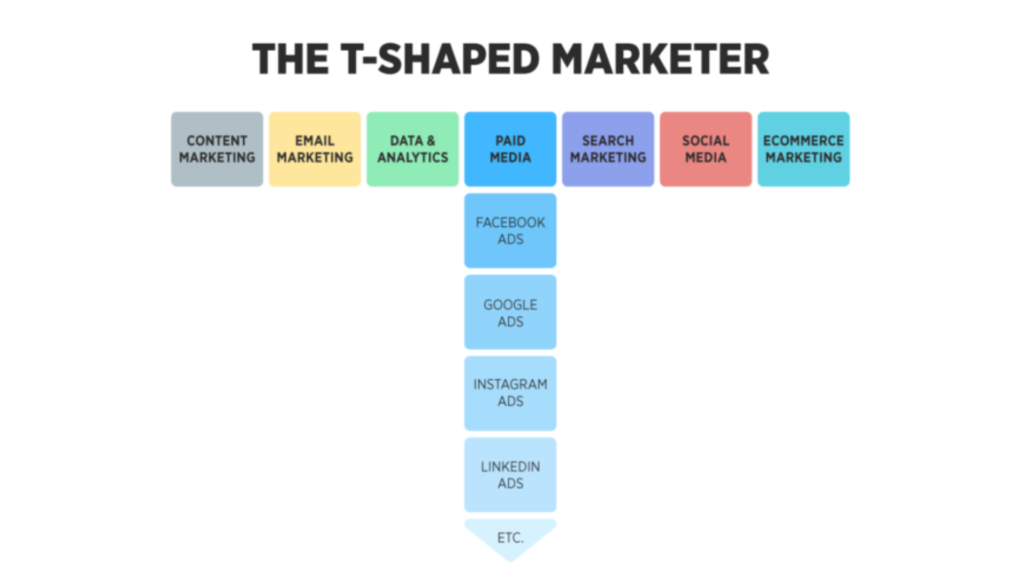
In a world where marketing evolves faster than platforms can update their algorithms, businesses no longer need “just” social media managers or SEO specialists. They need thinkers T-shaped digital marketers who understand the full spectrum of digital strategy yet master one skill deeply enough to drive measurable growth. The year 2026 marks a new era of marketing agility and the professionals leading it aren’t defined by tools, but by adaptability. What is a T-Shaped Marketer? A T-shaped digital marketer is someone who has broad knowledge across multiple marketing disciplines like SEO, paid ads, social media, email marketing, analytics, and content but deep expertise in one specific area. The vertical stroke of the “T” represents your core specialization (say, Performance Marketing or Content Strategy), while the horizontal stroke represents your understanding of how every other channel connects. It’s the difference between saying, “I run Google Ads,” versus, “I know how Google Ads, SEO, and social content together can lift overall brand performance.” A T-shaped marketer doesn’t just execute campaigns, they build ecosystems. The Death of One-Dimensional Specialization A few years ago, being a “Facebook Ads Expert” or “SEO Specialist” was enough to get hired. But in 2026, the landscape is brutally fast and integrated. Social algorithms shift every quarter. AI automation redefines what “technical expertise” even means. Brands demand marketers who can strategize across channels, not just within one. Startups, especially, can’t afford siloed roles. A marketer who understands email workflows, content funnels, and ad copy performance can save teams time, data, and resources while also scaling faster. That’s why the new rule is simple: Depth is valuable, but only when supported by breadth. . How to Build Your “T” You don’t wake up T-shaped, you build your “T” deliberately through projects, experimentation, and learning across channels. Here’s what that looks like in action: SEO + Paid Ads + Analytics: An SEO specialist learns how paid ads amplify organic reach and tracks keyword conversions through analytics. Content + Social Media + Email: A content creator understands how long-form blogs feed social storytelling and email drip sequences. Strategy + AI + Data: A strategist uses AI tools for keyword prediction, campaign optimization, and personalized audience targeting. The secret? Don’t chase every skill. Focus on learning how different channels support each other and how data flows across them. That’s what separates an executor from a strategist. How T-Shaped Marketers Help Businesses Win For startups, agencies, and brands, hiring T-shaped digital marketers means one thing: agility. Startups get professionals who can wear multiple hats and grow with the business. Agencies gain team members who understand how to integrate client campaigns across touchpoints. Brands benefit from marketers who can connect creative storytelling with performance outcomes. In short, they’re not just marketers, they’re growth architects. They see both the creative and analytical sides of marketing. They connect engagement to revenue. They translate metrics into business outcomes. And that’s the future of marketing leadership. UpskillNexus’s Model for Building Multi-Channel Professionals At UpskillNexus, the future marketer isn’t trained to be a “tool operator” but a strategic digital thinker. Every course, from foundation to specialization, blends core marketing fundamentals with exposure to emerging tools and channels including AI, automation, and data-driven storytelling. Students learn to: Think like strategists, not just executors. Integrate SEO, Paid Ads, Social Media, and Analytics. Use real-world tools to build portfolios that prove adaptability. By the end of their journey, they don’t just know marketing they understand how marketing works together. That’s the UpskillNexus difference: building T-shaped digital marketers ready to lead, not just follow trends. The Future Belongs to the T-Shaped The digital marketing ecosystem will only grow more complex new platforms, more AI tools, and data everywhere. But one skill will never go out of style: the ability to connect dots across disciplines and think strategically. That’s what being T-shaped truly means mastering one skill, understanding many, and adapting faster than change itself. If 2025 was the year of AI adoption, then 2026 is the year of adaptable marketers. And the most adaptable ones will be those shaped like a “T.”
Digital Marketing Course After 12th: A Smarter Career Move Than Waiting for a Degree

Most students are told the same thing after 12th pick a degree, wait three years, and only then think about their career. But what if you didn’t have to wait? What if you could start working, earning, and exploring real-world opportunities while everyone else was still figuring things out? That’s why so many students today are choosing a Digital Marketing Course after 12th. It’s not just a backup plan, it’s a fast-track to building a career without depending on traditional pathways. What Is Digital Marketing in Simple Words? Digital Marketing means helping brands grow online. It could be through Instagram reels, YouTube ads, Google ranking, email newsletters or content creation. If you’ve ever seen an ad before a YouTube video or a trending post on Instagram someone like you was behind it. The best part? You don’t need coding, a degree, or technical background. Just interest, consistency and the right training. Why Are Students Choosing Digital Marketing Courses After 12th in Delhi? Delhi has become a hotspot for job-oriented digital marketing courses, especially in places like Rajouri Garden, where institutes now offer AI-based digital marketing training with live projects. Instead of waiting years for a college placement, many students start earning within months through: Freelancing Social media management Content creation Junior digital marketing roles in startups and agencies How Much Can You Earn After Digital Marketing Courses Post 12th? Your income depends on how you choose to apply your skills. Some students start freelancing and make anywhere between ₹15,000 to ₹60,000 per month by managing Instagram pages, running ads, or writing content for small businesses. Those who choose job roles in companies usually begin with salaries around ₹4–6 lakhs per year, which increases quickly with experience. In fact, with consistent growth over 3–5 years, digital marketers often scale to ₹15–25 lakhs per year, especially in performance or AI-driven roles. How Long Does a Digital Marketing Course After 12th Take? Most professional courses range between 3 to 6 months. Some offer weekend batches for college-going students, while others allow hybrid learning offline or online based on convenience. Unlike traditional education, the goal isn’t just to complete the syllabus, it’s to become employable. What Will You Learn in a Good Digital Marketing Course? A solid curriculum should teach: How to research markets and understand consumer psychology How to rank websites on Google through SEO How to set up and optimize ads on Google and Meta (Facebook/Instagram) How to grow social media pages and plan content How to build email funnels and automate follow-ups How to track results using Google Analytics and Pixels How to use AI tools like ChatGPT, Canva AI or automation platforms How to deal with clients, price your services and build your brand This is not just about learning it’s about learning how to apply what you learn. What Career Paths Can You Take After the Course? There’s no single path. You get to create your own. Some learners choose freelancing, taking projects on platforms like Fiverr, Upwork or even via Instagram DMs. Some take jobs in digital marketing agencies, startups or media firms, handling ads, content or SEO. Some launch their own businesses or niche pages, turning passion into income. Some become content creators or influencer strategists, using marketing to grow audiences. Whether you prefer stability, freedom or flexibility, digital marketing gives all three. So, What’s the Best Digital Marketing Course After 12th in Rajouri Garden? The best course is not the one with fancy certificates. It’s the one that: Makes you practice on real campaigns, not just watch lectures Teaches you AI tools and automation, not outdated methods Trains you to handle clients and build your professional presence Helps you walk out with a portfolio, not just notes If a course can do that, you’re not just learning digital marketing you’re becoming a digital marketer. Your journey after 12th doesn’t have to be slow, confusing or dependent on waiting for a degree. With the right skill, you can earn, learn and grow simultaneously. So instead of asking “Which field should I choose?”, maybe ask: “Which field gives me control over my future?” Digital Marketing just happens to be one of them.