
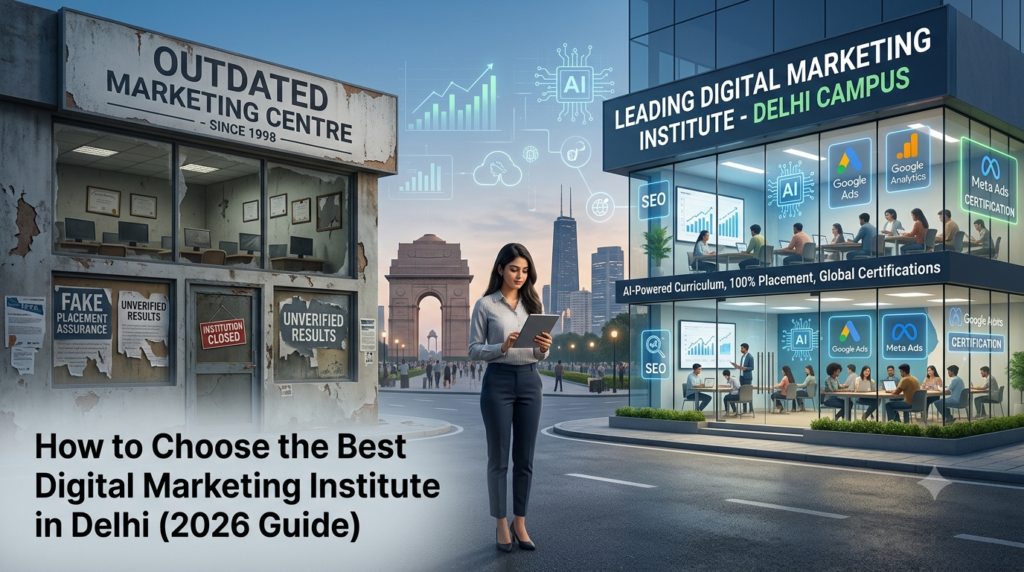
Delhi has no shortage of institutes promising to make you job-ready in 3 months. Some are excellent. Many are a slide deck, a WhatsApp group, and a placement cell that stops replying after you’ve paid. The problem isn’t finding an institute — it’s telling the two apart before you’ve spent the money.
This is a practical checklist, not a sales pitch. Use it to evaluate any institute you’re considering, including ours.
Start with the curriculum, not the brochure
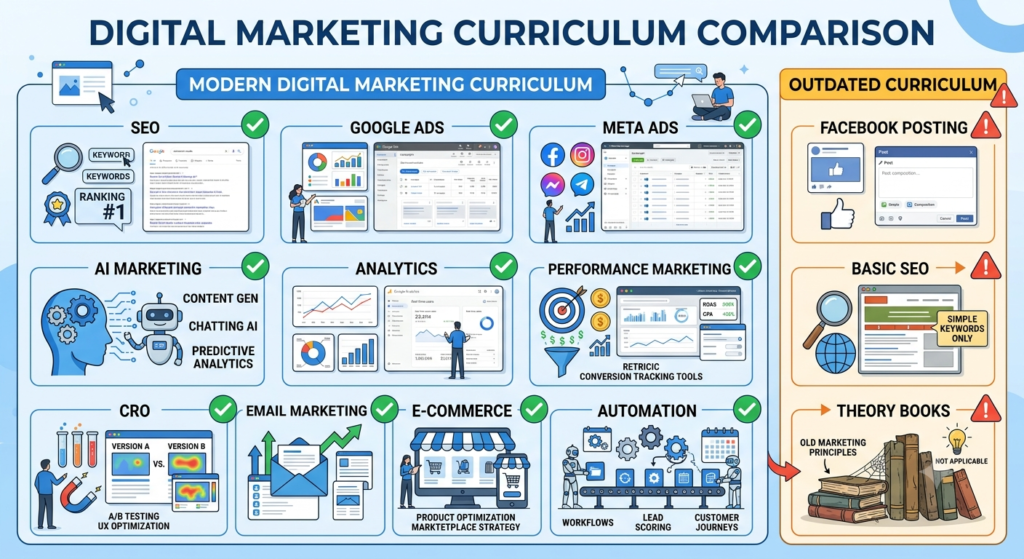
Brochures are marketing. What matters is the actual module breakdown — ask for it before you enrol, not after.
A genuinely modern digital marketing curriculum in 2026 should cover, at minimum:
– Search marketing — SEO (on-page, technical, local) and SEM/Google Ads, not just one or the other.
– Social media — organic strategy *and* paid campaigns (Meta Ads, not just “posting content”).
– Performance marketing & CRO — landing pages, funnels, conversion rate optimisation.
– Analytics — GA4 and Google Tag Manager specifically; older institutes still teaching Universal Analytics are behind.
– AI in marketing — prompt engineering and AI tools for content, research and automation. If a course doesn’t mention AI at all in 2026, that’s a red flag on its own.
– E-commerce or affiliate marketing, if you’re interested in that track.
Ask: how many modules, how many hours of live (not recorded) instruction, and what’s the practical-to-theory ratio? An 80/20 practical-to-theory split is a reasonable industry benchmark — anything mostly lecture-based will leave you with knowledge but no portfolio.
Check what tools you'll actually get hands-on with

A good institute teaches on real, current tools — not just talks about them. At minimum, look for hands-on time with:
– SEO/analytics tools — Google Search Console, Google Analytics, Semrush or Moz, Google Keyword Planner.
– Ad platforms — Google Ads (with its transparency center), Meta Business Suite.
– Content & design— Canva, Grammarly, a website builder like WordPress or Elementor.
– AI tools — ChatGPT, Claude, Gemini and at least one AI content/creative tool.
– Reporting — Google Looker Studio or an equivalent dashboarding tool.
If an institute can’t name specific tools you’ll work in — only “we cover Google Ads and SEO” — push for specifics before you pay.
Ask about certifications — but verify what's actually included

Institutes advertise certifications heavily, and it’s easy to conflate “we prepare you for X certification” with “X certification is included in the fee.” They’re not the same thing.
Ask directly:
1. Which certifications are included in the course fee, and which are optional, at extra cost?
2. Are they platform certifications (Google, Meta, HubSpot) or only the institute’s own certificate?
3. Is there a genuine assessment—practical and theoretical — or is the certificate given on attendance alone?
A program with a real, dual (practical + theoretical) assessment and a mix of institute + platform certifications is a stronger signal than one offering a single “master certificate” with no breakdown.
Placement support: ask how, not just if
Almost every institute claims “placement assistance.” Almost none define what that means. Before you enrol, ask specifically:
– Does support include interview preparation, resume building and LinkedIn optimisation — or just a WhatsApp group of job postings?
– Is there an internship built into the program, or is placement help only after the course ends?
Is placement "guaranteed," or is it phrased as assistance "as per company policy"?
Be sceptical of any institute promising guaranteed placement — hiring ultimately depends on your performance in interviews and the hiring company’s decision, and no institute controls that outcome. A credible institute will phrase this honestly rather than promise a job.
Location and format — be realistic about your own habits
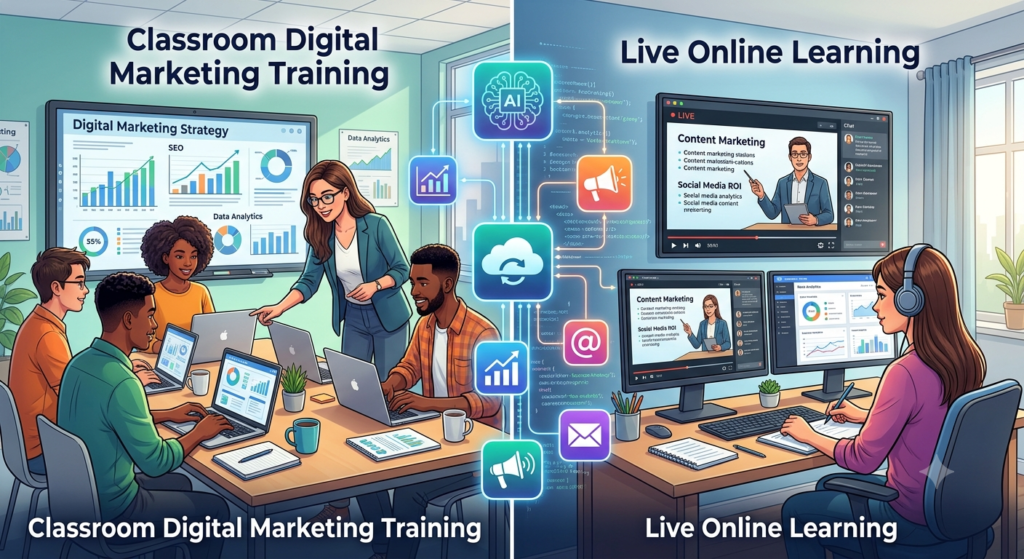
Delhi NCR has real commute costs (time, money, energy) that affect whether you’ll actually finish the course. Before choosing:
– If you’re picking an offline/classroom program, check the actual commute from your home or office — not just “it’s in Delhi.” An institute in Rajouri Garden convenient for West Delhi (Tilak Nagar, Janakpuri, Subhash Nagar, Tagore Garden) may be a poor fit if you’re based in Noida or Gurugram, and vice versa.
– If online works better for your schedule, confirm the online batches are live and instructor-led, not just pre-recorded videos with no interaction.
– Ask about batch size. Smaller batches generally mean more mentor time per student — worth asking directly what the typical batch size is.
Fees: what to ask (and what to ignore)
Most reputable institutes don’t publish fees openly on their website, since pricing often depends on the specific track, batch and any ongoing offers — that’s normal, not a red flag by itself. What is worth asking directly:
– What’s included in the base fee — is there anything charged separately later (certifications, resources, retake fees)?
– Are there need-based scholarships or EMI options, and what’s the actual process to apply?
– Can you get the fee structure in writing before you commit, rather than relying on a verbal quote?
Ignore high-pressure “offer ends today” tactics. A genuine institute will let you take a free demo class and think it over.
Red flags that should make you walk away
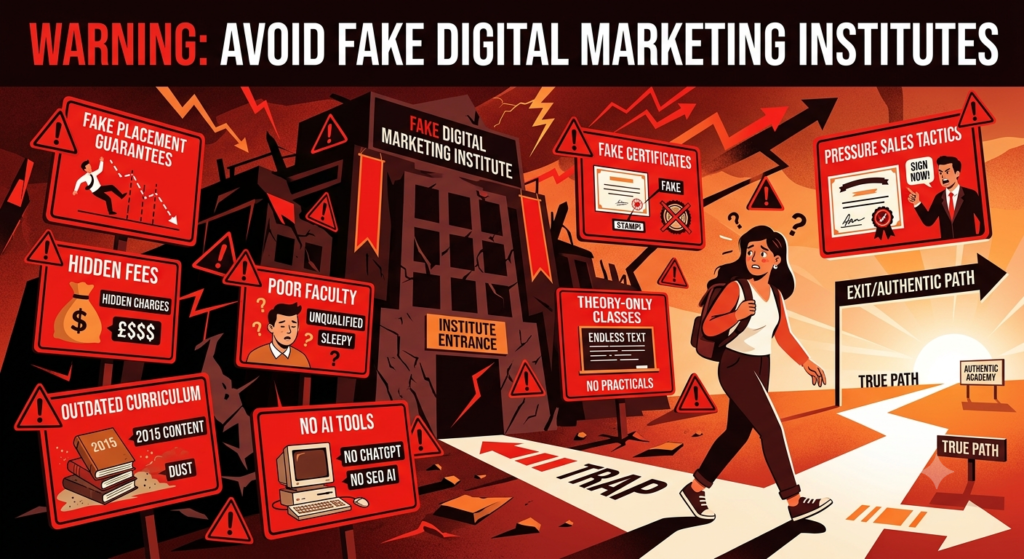
– Guaranteed placement or a specific guaranteed salary. No legitimate institute can guarantee an employer’s hiring decision.
– No live projects or portfolio component — a course that’s 100% theory won’t get you hired on its own.
– Vague answers about faculty. Ask who’s actually teaching — working professionals in the field, or only full-time trainers with no current industry experience?
– Pressure to enrol immediately without a demo class or a chance to review the curriculum.
– No mention of AI tools anywhere in the curriculum, in a field that’s changed this much in the last two years.
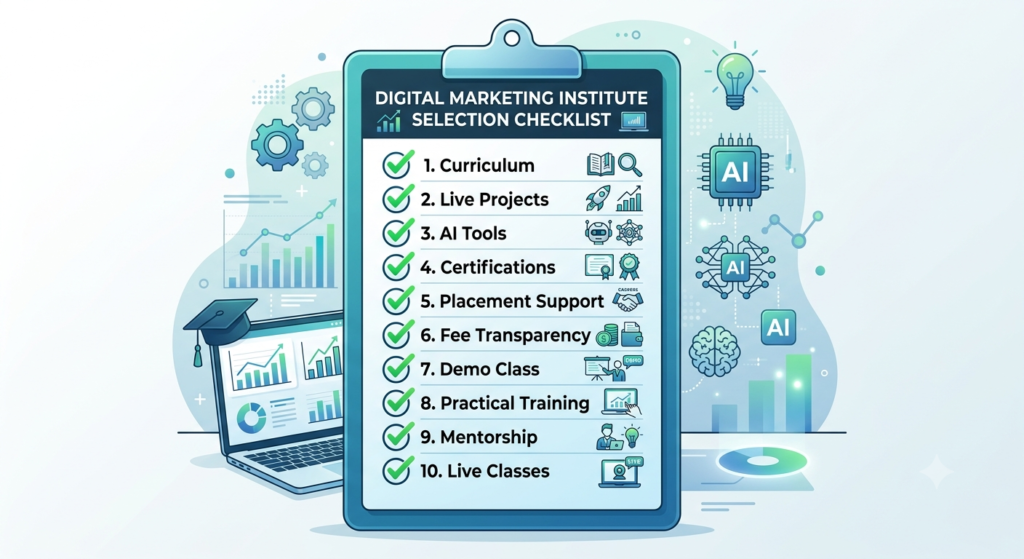
A quick checklist before you enrol anywhere
Before signing up for any digital marketing institute in Delhi, you should be able to answer:
– [ ] What’s the exact module count and live training hours?
– [ ] Which specific tools will I get hands-on practice with?
– [ ] Which certifications are included vs. optional/extra cost?
– [ ] What does placement support actually include, and how is it phrased (assistance vs. guarantee)?
– [ ] Is the batch classroom, live-online, or both — and does that fit my schedule?
– [ ] What’s the fee structure, and are scholarships or EMI available?
– [ ] Can I attend a free demo class before deciding?
If an institute can answer all seven clearly and in writing, you’re evaluating a serious program. If they dodge two or more, keep looking.
Where UpskillNexus fits
For transparency: UpskillNexus’s own CDMS (Certified Digital Marketing Specialist) program is built to answer every item on this checklist — 9 courses across 54+ modules, 160+ hours of live (not recorded) training, 50+ tools including 21+ AI tools, an 80% practical / 20% theory structure, and both classroom (Rajouri Garden) and live-online batches. Fees aren’t published here for the reasons above — contact us for the current structure and need-based scholarship options
If you’re still weighing whether digital marketing is the right career at all before choosing *where* to study it, read our companion post: [Is digital marketing a good career in India?]
Frequently asked questions
1. What should I check before joining a digital marketing institute in Delhi?
Curriculum depth (module count, live hours, practical-to-theory ratio), the specific tools you’ll use hands-on, which certifications are included vs. optional, how placement support is actually structured, and whether the fee structure and any scholarships are given to you in writing.
2. Is a digital marketing certificate from any institute equally valuable?
No. Value comes from what you can *do* with it — a certificate backed by real live projects, current tools (GA4, Google Ads, Meta Ads, AI tools) and a genuine assessment carries far more weight with employers than attendance-based certificates alone.
3. Should I choose an offline or online digital marketing course in Delhi?
Depends on your commute and learning style. Offline suits people close to the institute who want structured, in-person accountability; live-online suits people further away or with tighter schedules — as long as it’s genuinely live and instructor-led, not pre-recorded.
4. Is placement guaranteed at digital marketing institutes in Delhi?
No credible institute can guarantee an employer’s hiring decision. Be cautious of any institute promising guaranteed placement or a specific guaranteed salary — look instead for institutes that clearly describe their placement *support* (interview prep, resume help, referrals) and phrase outcomes honestly, such as “as per company policy.”
5. How much does a digital marketing course cost in Delhi?
Fees vary by institute, track and duration, and most reputable institutes share exact pricing only on request rather than publishing it, since it depends on the specific program and any ongoing offers. Always ask for the fee structure in writing, and ask specifically about need-based scholarships or EMI options before enrolling.
Want to compare us against this checklist yourself? [Book a free demo class] — no pressure, just a chance to see the curriculum and ask us the hard questions directly