Home » The Invisible Threat: Cybersecurity Risks in Augmented Reality (AR) Applications
The Invisible Threat: Cybersecurity Risks in Augmented Reality (AR) Applications
Imagine this:
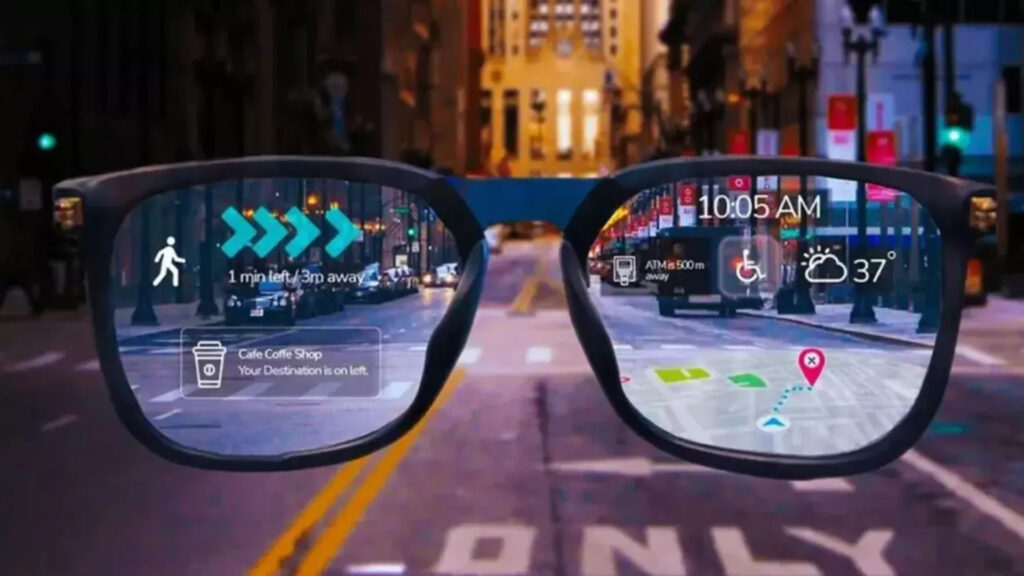
You’re navigating an AR app that indicates the quickest path through a crowded city. Suddenly, the directions change, directing you into a closed-off area you shouldn’t go into. No glitch. No errors.
Just an attacker, taking over your augmented reality.
Sounds like science fiction? It’s already here.
Why Should We Worry About AR Security?
Augmented Reality is blowing up across sectors — gaming, healthcare, logistics, education — name it. But with each virtual overlay comes a secret danger: new methods for hackers to manipulate, steal and deceive.
And here’s the kicker: Most AR users — and many brands — aren’t prepared.
Top Cybersecurity Threats Hiding in AR Applications
Let’s get down to it: what exactly can go wrong?
Your Data—Exposed
AR apps are obsessed with data: location, faces, and movements. Shopping habits.
If this goldmine isn’t encrypted correctly, hackers can steal it with ease.
Reality Hijacking
Yes, it’s a real thing.
Attackers can introduce spurious digital content into your AR experience — deceiving users, inducing poor choices or worse, harming people in the real world.
Consider your warehouse AR app identifying dangerous chemicals as safe. Now consider the fallout.
Man-in-the-Middle (MitM) Attacks on Live AR Streams
Live AR content streams back and forth between servers and devices.
Without bulletproof encryption, a hacker can intercept and manipulate what you see — invisibly.
Weak AR Devices = Easy Targets
AR smart glasses and headsets tend to be less secure than smartphones.
One trade-off, that hackers can snoop through your peepers and ears, capturing without your permission.
Third-Party SDK Pitfalls
Developers commonly employ pre-made AR toolkits (SDKs) to accelerate app development. But if the SDK is buggy?
Every app created with it carries the vulnerability. Ow.
The vulnerability was fixed quickly, but it highlighted how vulnerable a popular AR app could be to leaving serious personal information.
So, How Can We Make AR Safer?
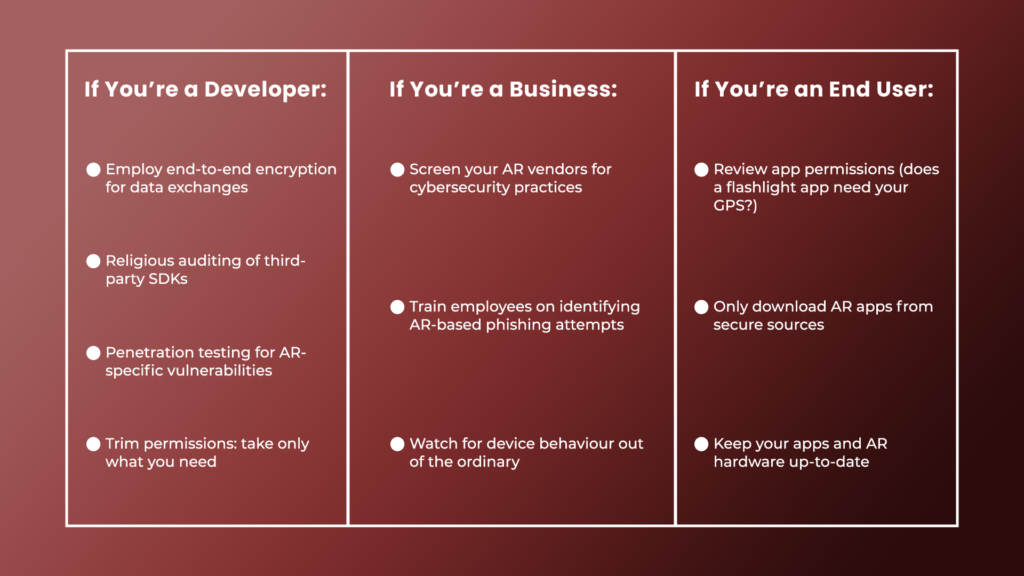
Great question. Here’s your 3-Point Action Plan, whether you’re a developer, business leader, or AR user:
If You’re a Developer:
Employ end-to-end encryption for data exchanges
Religious auditing of third-party SDKs
Penetration testing for AR-specific vulnerabilities
Trim permissions: take only what you need
If You’re a Business:
Screen your AR vendors for cybersecurity practices
Train employees on identifying AR-based phishing attempts
Watch for device behaviour out of the ordinary
If You’re an End User:
Review app permissions (does a flashlight app need your GPS?)
Only download AR apps from secure sources
Keep your apps and AR hardware up-to-date
Last Thought: Seeing Is No Longer Believing
AR fuses digital and physical realms in ways we’ve never known.
But unless we’re cautious, the very devices intended to empower us may be used against us.
In AR, what you see isn’t necessarily what’s real.
Cybersecurity in AR isn’t a choice — it’s survival.