
There is no doubt that the software development industry is undergoing a rapid transformation, and Google has explicitly declared that it has a place in the competition for state-of-the-art AI coding tools by introducing Antigravity Google.
A powerful new agentic development platform for front-end engineers, full-stack developers, and professional developers is presented as Google Antigravity.
This integrated development environment (IDE) is not only a competitor to Visual Studio Code but also encompasses Google’s concept of the “agent-first” epoch in which smart AI agents will be cooperating with developers, performing tasks that are normally done by humans, and producing applications that are deployment-ready in a much shorter time than before.
Antigravity enables developers of all skill levels to utilize advanced, smooth, and efficient coding tools. And the best part?
It is entirely free of charge.
What Is Google Antigravity?
Google Antigravity is an advanced IDE specifically for building agentic AI, that is, it is designed to be used for the development of agents by giving them some form of autonomy or control.
It features:
- AI-powered coding agents
- Control centers
- Real-time user interface integration
- Browser-based feedback loops
- Support for full-stack, front-end, and professional workflows
Think of it in the way of the evolution of traditional IDEs like VS Code, Cursor, or JetBrains, but now with AI agents co-working with you for coding, debugging, and task management purposes.
Important Features and Highlights
Ultimate IDE for Agentic AI
In a confident turn, Google brings Antigravity as a competitor to IDEs like VS Code and Cursor:
Agents’ Mission Management
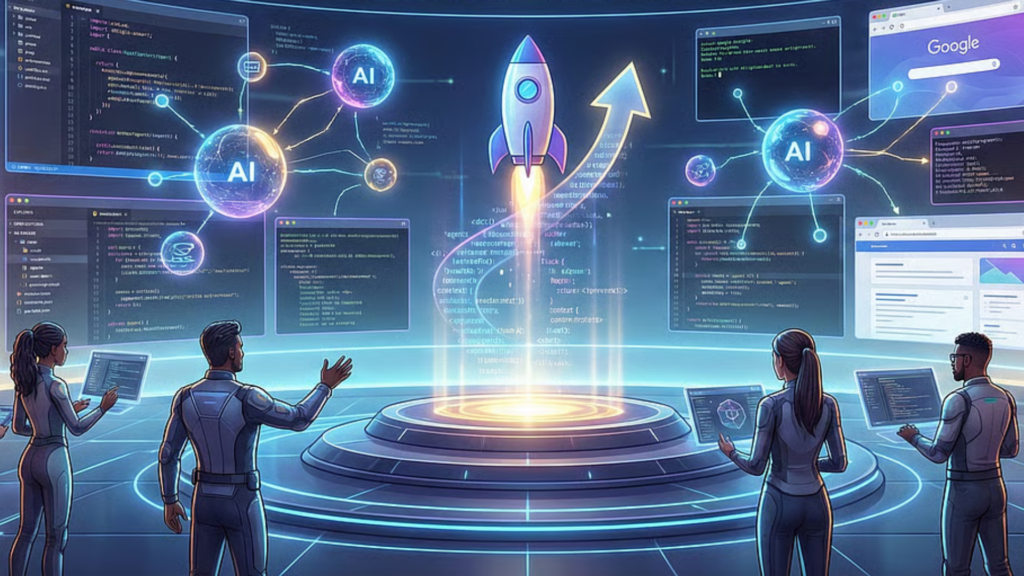
Through Antigravity’s mission control surface, developers are able to:
- Watch agents that work in the background
- Perform automatic code evaluation
- Give out tasks and track outcomes
- Reduce manual work significantly
The process of coding is more like leading a group rather than doing the dirty work since agents take care of the boring job while you deal with logic, architecture, and creativity.
Utilizing Google's Gemini Models
The most recent AI models from Google, Gemini 3 and Gemini 5, significantly enhance: performance
- speed
- logic
- Long-context coding
- handling tasks in multiple steps
Antigravity is a sophisticated AI-powered IDE for developers that makes extensive use of these models.
Decreased Context Switching
Rather than switching between documents, tabs in a browser, and editors, Antigravity:
- streamlines processes in parallel
- controls knowledge inside the IDE
- permits agents to operate “behind the scenes.”
- This helps developers stay focused and saves time.
Google Provides Free Advanced Tools
Among the greatest surprises?
Google is providing robust AI tools at no cost, such as:
- Gemini 3 Pro
- Code in the Cloud
- Tools for real-time UI feedback
Antigravity is therefore perfect for
- students
- Novices
- Independent developers
- Startups
Anyone interested in learning without having to pay a subscription fee
Integration of Real-Time UI
Changes are instantly visible to developers in the browser, which greatly enhances:
- UI design
- front-end processes
- troubleshooting user interactions
Different Modes of Development
Agent-driven development, in which agents do the majority of the work.
Agent-assisted development: you maintain control while receiving AI assistance
A Well-Known, Developer-Friendly Interface
For developers accustomed to Visual Studio Code, Google Antigravity’s interface is comfortable.
Among the features are:
- Explorer for files
- Support for multiple projects
- Chat panel for agents
- Templates for projects
- Rich code editor
- Advanced features in a free version
The most impressive part, perhaps?
A chat-style agent is integrated right into the IDE.
This implies:
- obtain inline recommendations
- Request clarifications
- Request reviews of the code
- Create tests right away
Strong Coding Agents With Inline Editing
Antigravity’s coding agents are capable of much more than just producing snippets.
They provide:
- inline editing
- management of tasks
- Suggestions for improvement
- directed changes to the code
- Orchestration of multiple agents
This makes the coding environment more structured and expert, particularly for:
- ongoing projects
- deep research assignments
- cooperative processes
Support for Extensions
For instance,
the Python extension
Python tools for Microsoft
Additional language integration
Due to this, Antigravity can be utilized in a variety of programming environments.
Support for Python and Quick Setup
Installing Python within Antigravity enables you to:
- Execute code immediately
- control dependencies
- quickly create backend systems
Extra advantages include a familiar terminal interface (like GitHub Copilot).
- quick project creation
- smooth code committing
- execution of commands in real time
Constructing a FastAPI Calculator as a Basic Example
The video shows how simple it is to use FastAPI to create an application.
Highlights of the process:
- start a new project.
- Create several backend routes.
- launch the development server.
- Test in the browser right away.
- FastAPI is renowned for its
- speed.
- contemporary style
- async capabilities
- experience with clean development
This example demonstrates how quickly full-stack apps can be developed within Antigravity.
Although it’s not flawless yet, the user interface is quick, easy to use, and developer-friendly.
The Significance of Google Antigravity
Antigravity is marketed by Google as a professional-level AI IDE.
An agent-first development platform
An environment in which humans and AI agents co-code
A complimentary toolkit when rivals are compensated
This makes advanced development accessible to everyone and democratizes powerful tools.
Conclusion
Google Antigravity is the beginning of a new era in software development, not just an IDE.
An era in which developers and agents work together
Coding gets smarter and faster.
Real-time UI feedback
Workflows are optimized
Tools are available and free.
This is one of the most crucial AI-powered IDEs to investigate in 2025, regardless of your level of experience as an engineer.