
Tihar Jail Recognises UpskillNexus on Independence Day for Contribution Towards Inmate Welfare, Reformation and Rehabilitation
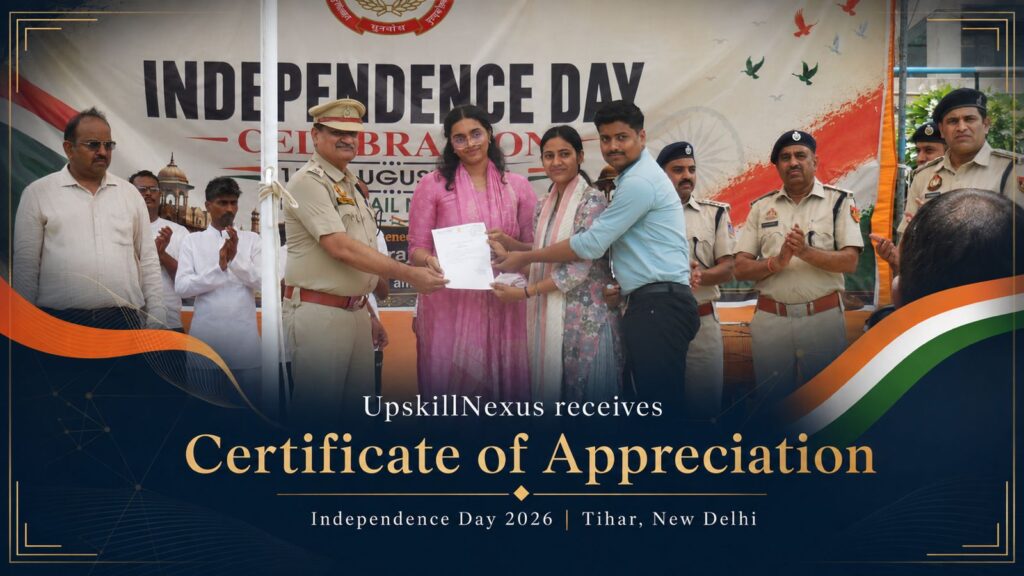
New Delhi | 15 August 2026: On the occasion of India’s 80th Independence Day, UpskillNexus was invited to participate in the Independence Day celebrations at Central Jail No. 8/9, Tihar, New Delhi, where our organisation received a Certificate of Appreciation from the Prison Administration in recognition of its contribution towards the welfare, reformation and rehabilitation of inmates. The certificate was presented by Dheeraj Mathur, Superintendent of Prison, Central Jail No. 8/9, Tihar, and formally acknowledges the contribution and dedicated efforts of UpskillNexus towards bringing positive change in the lives of inmates. For UpskillNexus, being recognised in the presence of the prison administration on Independence Day made the occasion particularly meaningful. It was not simply an acknowledgement of our efforts. It represented the larger role that education, awareness and skills can play in creating capability and positive change across different sections of society. A Meaningful Independence Day Recognition Independence Day is a reminder of the responsibilities that come with freedom — and of the work required to build a stronger, more capable and more inclusive India. For UpskillNexus, receiving this recognition at Tihar Jail on 15 August added a different dimension to that idea. The Certificate of Appreciation specifically recognises UpskillNexus’s contribution towards the welfare, reformation and rehabilitation of inmates, while placing on record the Prison Administration’s appreciation and gratitude for the organisation’s efforts. The recognition follows UpskillNexus’s engagement with Tihar Jail, including an Artificial Intelligence and Cybersecurity Awareness Session conducted for officials and staff of Central Jail No. 8/9. Approximately 40–50 participants took part in the awareness session, which focused on emerging technology, cybersecurity, digital safety and responsible use of Artificial Intelligence. The earlier engagement was designed around a simple objective: making complex and rapidly changing technology more understandable, practical and relevant to the people using it. A National Conversation Around Skills and Technology The timing of the recognition also coincided with a significant national conversation around skills and technology. In his Independence Day address from the Red Fort on 15 August 2026, Prime Minister Narendra Modi announced a target to provide Artificial Intelligence skilling to 1 crore young Indians over the next year. The announcement placed AI capability and future-ready skills prominently within India’s broader development agenda. The significance of this goes beyond Artificial Intelligence alone. India’s technological transformation is creating a growing need for people who can understand, use and adapt to new technologies. Artificial Intelligence, cybersecurity, automation and digital systems are increasingly becoming part of education, employment, governance and everyday life. The national focus on AI skilling reflects an increasingly important reality: capability-building is becoming a critical part of India’s next phase of growth. At UpskillNexus, this is closely aligned with why we exist. We believe that skills are not simply tools for getting a job. They can help individuals become more capable, confident and adaptable in a rapidly changing world. And that principle applies far beyond the conventional classroom. From Cybersecurity Awareness to Institutional Engagement The recognition from Tihar follows an earlier AI and Cybersecurity Awareness Session conducted by UpskillNexus for officials and staff at Central Jail No. 8/9. The session brought together approximately 40–50 participants and covered practical aspects of technology and cybersecurity, including: Artificial Intelligence and its real-world applications Emerging cybersecurity threats Phishing and social engineering Password security and multi-factor authentication Digital privacy and data protection Safe internet browsing Digital forensics Cybercrime awareness Responsible use of Artificial Intelligence Practical digital safety practices The session focused on real-world examples rather than technical terminology alone. Participants explored how cybercriminals exploit human behaviour, how AI is changing the threat landscape and how simple security practices can reduce digital risks. The engagement reinforced an important point: cybersecurity awareness is not merely the responsibility of IT professionals but also an institutional responsibility. Our earlier article on the engagement covers the session and its key takeaways in greater detail. Read: UpskillNexus Conducts AI & Cyber Security Awareness Session for Tihar Jail Officials Why Cybersecurity Awareness Matters Across Institutions As institutions become increasingly dependent on digital systems, cybersecurity awareness has become an important part of organisational resilience. Government institutions, businesses, educational organisations and public institutions increasingly rely on digital communication, connected devices, databases and online services. This creates new opportunities, but it also creates new risks. Phishing attacks, social engineering, identity theft, ransomware, malicious links and AI-enabled scams are becoming increasingly sophisticated. At the same time, Artificial Intelligence is making it possible to automate and personalise many forms of digital fraud. This makes AI and cybersecurity training increasingly relevant across sectors. For organisations, cybersecurity moves beyond a technical function. It also depends on the awareness and behaviour of the people who interact with digital systems every day. That is why cybersecurity awareness programmes can play an important role in building a stronger digital culture. At UpskillNexus, our approach to cybersecurity training has always been centred around practical learning — helping participants understand not only what a cyber threat is, but also how it can affect their everyday digital behaviour. Skills, Education and the Larger Idea of Rehabilitation The Certificate of Appreciation is particularly significant. The Prison Administration recognised UpskillNexus for its contribution towards the welfare, reformation and rehabilitation of inmates. Rehabilitation is a complex process. It involves much more than any single intervention, training programme or awareness session. However, education and skill development can form an important part of that larger ecosystem. Skills alone cannot define rehabilitation. But the ability to learn, develop capabilities and engage with a changing world can be an important part of preparing individuals for reintegration into society. This is why the recognition from Tihar matters to us. It acknowledges that our contribution, even through a focused institutional engagement, can form part of a much larger effort towards welfare, reformation and rehabilitation. Taking Skill Development Beyond the Conventional Classroom Skill development is often discussed in the context of colleges, universities, corporate workplaces and training centres. But the need for relevant knowledge does not stop at the boundaries of a classroom. Students need digital skills. Professionals need